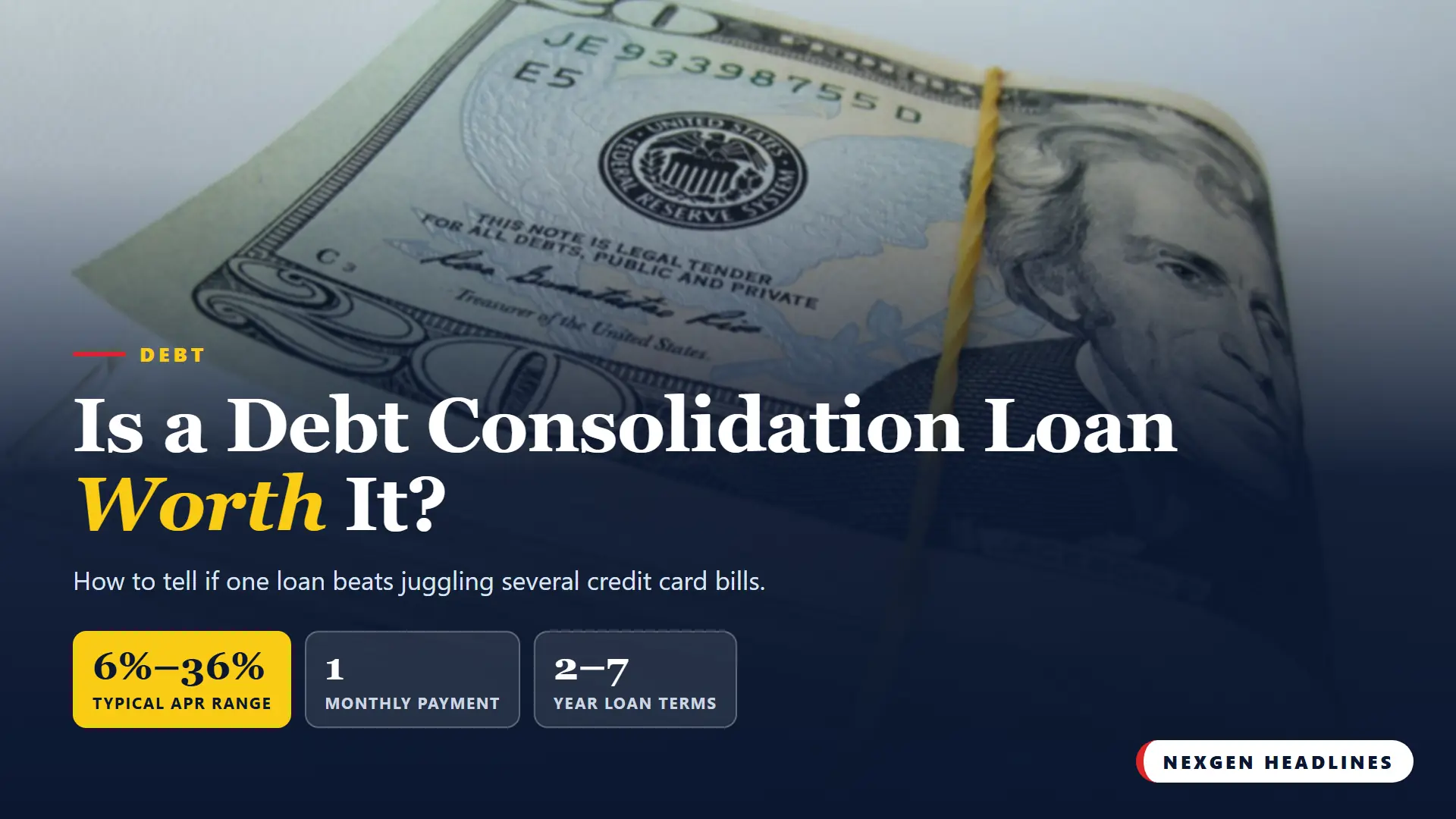

Quick answer: A debt consolidation loan is worth it when its APR is clearly lower than what your cards charge, the fees are small, and you stop adding new card debt. Personal loan rates typically run from about 6% to 36%, depending mostly on your credit.
Juggling five card bills is stressful. One loan with one due date sounds like relief. Sometimes it is. Here is how to tell, with real math.
How a debt consolidation loan works
- You apply for a personal loan from a bank, credit union or online lender.
- If approved, the lender pays off your cards, or sends you the money to do it.
- You repay the loan in fixed monthly payments, usually over 2 to 7 years.
- Your rate is fixed, so the payment doesn’t change.
| Feature | Credit cards | Consolidation loan |
|---|---|---|
| Number of payments | One per card | 1 monthly payment |
| Interest rate | Variable, often around 20% or more | Fixed, about 6% to 36% |
| End date | None if you only pay minimums | Set payoff date |
| Fees | Late fees, annual fees | Possible origination fee |
For a sense of the gap: Bankrate reported an average credit card rate of 19.58% and an average personal loan rate of 12.04% in April 2026. Your rates will depend on your credit.
The math: a side-by-side example
This is an illustration with rounded numbers. Your own offer will differ.
| Keep paying cards | Consolidation loan | |
|---|---|---|
| Debt | $15,000 | $15,000 |
| Rate | 22% APR | 12% APR, 4 years |
| Monthly payment | $395 | $395 |
| Time to pay off | About 5.5 years | 4 years |
| Total interest | About $10,900 | About $4,000 |
Same monthly payment, and the loan finishes about a year and a half sooner with thousands less in interest. Even with a 5% origination fee ($750 here), the loan still comes out well ahead.
When it is worth it
- Your new APR is several points lower than your average card rate.
- You can afford the monthly payment without using cards for daily costs.
- Your credit is fair to excellent, so you qualify for a decent rate.
- You want a fixed end date instead of an endless minimum payment.
When it is not worth it
- The loan’s APR, including fees, is close to or higher than your card rates.
- You would stretch the term so long that you pay more total interest.
- The cause of the debt, like a budget gap, hasn’t been fixed yet.
- Your debt is small enough to clear in about a year with a 0% balance transfer card.
Also read: How to Pay Off Credit Card Debt
Fees and fine print to check
Origination fee
Many lenders charge a one-time fee, taken out of the loan amount. Some lenders charge none. A fee means you may need to borrow a bit more to fully pay off your cards.
APR vs. interest rate
Compare APR, not just the interest rate. APR includes the origination fee, so it shows the real yearly cost.
Prepayment penalty
Most personal loans have none, but ask. You want the freedom to pay early.
Fixed rate
Confirm the rate is fixed. The CFPB has warned about “teaser” rates that jump after a few months.
How to get a consolidation loan, step by step
- List every debt: balance, APR and minimum payment.
- Check your credit free at AnnualCreditReport.com and fix any errors.
- Prequalify with 3 or more lenders. Many use a soft check that doesn’t affect your score.
- Include a credit union. They often have lower rates and fees for members.
- Compare APR, term, monthly payment and total cost.
- Choose direct payoff if the lender offers it, so the money goes straight to your cards.
- Set autopay. Some lenders give a small rate discount for it.
What if you don’t qualify for a good rate?
If the offers you get are close to your card rates, the loan won’t help much. You still have options:
- Wait 3 to 6 months while paying every bill on time and lowering your card balances. Then apply again.
- Ask a credit union where you already bank. Some look at your whole relationship, not just your score.
- Consider a co-signer only if both of you understand that person is fully responsible if you don’t pay.
- Try a nonprofit credit counselor. A debt management plan can lower rates without a new loan.
What to do the day the loan arrives
- Confirm every card shows a zero balance, or pay them yourself right away if the money went to your bank.
- Turn off autopay on the old cards so nothing gets charged twice, and set autopay on the new loan.
- Remove saved cards from shopping sites and apps to cut the urge to spend.
- Start a small emergency fund, even $500, so the next car repair doesn’t go on a card.
A made-up example
These are made-up examples to show how the choice plays out. They are not real people.
“Tasha”, a teacher in Georgia, has four cards totaling $12,000 at rates from 21% to 27%. Her credit score is in the low 700s.
She prequalifies with three lenders and her credit union. The credit union offers 11% for 4 years with no fee. Her payment drops from about $480 in combined minimums to about $310. More important, she has an end date.
She keeps one card for emergencies and freezes the others in a drawer. Four years later, she’s done.
“Kevin” takes a similar loan but keeps using his cards. Two years later, he has the loan payment and new card balances. His total debt is higher than when he started.
The loan doesn’t fix spending. It only fixes the interest rate.
How it affects your credit score
Applying brings a hard inquiry, which may lower your score slightly for a while. A new loan also lowers the average age of your accounts.
But paying off cards usually lowers your credit utilization, a big part of your score. Many people see their score improve within a few months, as long as they pay on time. Our guide on how to raise your credit score explains why.
Other ways to consolidate
| Option | Pros | Cons |
|---|---|---|
| 0% balance transfer card | No interest during promo | Transfer fee; needs good credit; short window |
| Debt management plan (nonprofit) | Lower rates negotiated for you | Cards usually closed; small monthly fee |
| Home equity loan or HELOC | Often lower rates | Your home is collateral |
| 401(k) loan | No credit check | Hurts retirement savings; risky if you leave your job |
Be careful turning card debt, which is unsecured, into debt backed by your house. If you can’t pay, you could risk losing it.
Red flags: avoid these offers
- Upfront fees before you get any loan. The FTC warns this is a common scam sign.
- “Guaranteed approval” with no credit check.
- Pressure to decide today.
- A “consolidation” company that tells you to stop paying your cards. That is usually debt settlement, which can badly hurt your credit.
If you are already behind, read our guide on what to do if you can’t pay your credit card bill first.
Recommended products
Tools that help you stay on track after consolidating:
- Debt payoff tracker planners
- 2027 budget planners
- Cash envelope budgeting wallets
- Personal finance books for beginners
Disclosure: As an Amazon Associate, Nexgen Headlines earns from qualifying purchases.
FAQ
What credit score do I need for a debt consolidation loan?
Lenders set their own rules. Some approve fair credit, but the lowest rates usually go to people with good to excellent scores and steady income.
Will a consolidation loan hurt my credit?
There may be a small, short-term dip from the credit check. Over time, paying down cards and paying on time usually helps your score.
Should I close my credit cards after consolidating?
Not necessarily. Closing cards can raise your utilization and shorten your credit history. Many people keep them open with a zero balance and put them away.
Is debt consolidation the same as debt settlement?
No. Consolidation means you repay everything with a new loan. Settlement means trying to pay less than you owe, usually after falling behind, which can seriously damage your credit.
How fast can I get the money?
Many online lenders fund approved loans within a few business days, and some say the next day. Banks and credit unions may take a bit longer. Keep paying your cards until they show a zero balance.
Bottom line
A debt consolidation loan is worth it when it gives you a clearly lower APR, small fees and a payment you can keep. Prequalify with several lenders, include a credit union, and stop adding card debt so the loan actually gets you out.
Last reviewed: Oct. 27, 2026. This guide is general information, not financial advice. Rates change often.
Sources: Consumer Financial Protection Bureau; FTC: How to get out of debt; Bankrate: pros and cons of debt consolidation; AnnualCreditReport.com.
Featured image: 401(K) 2012 / Wikimedia Commons, CC BY-SA 2.0, edited by Nexgen Headlines.