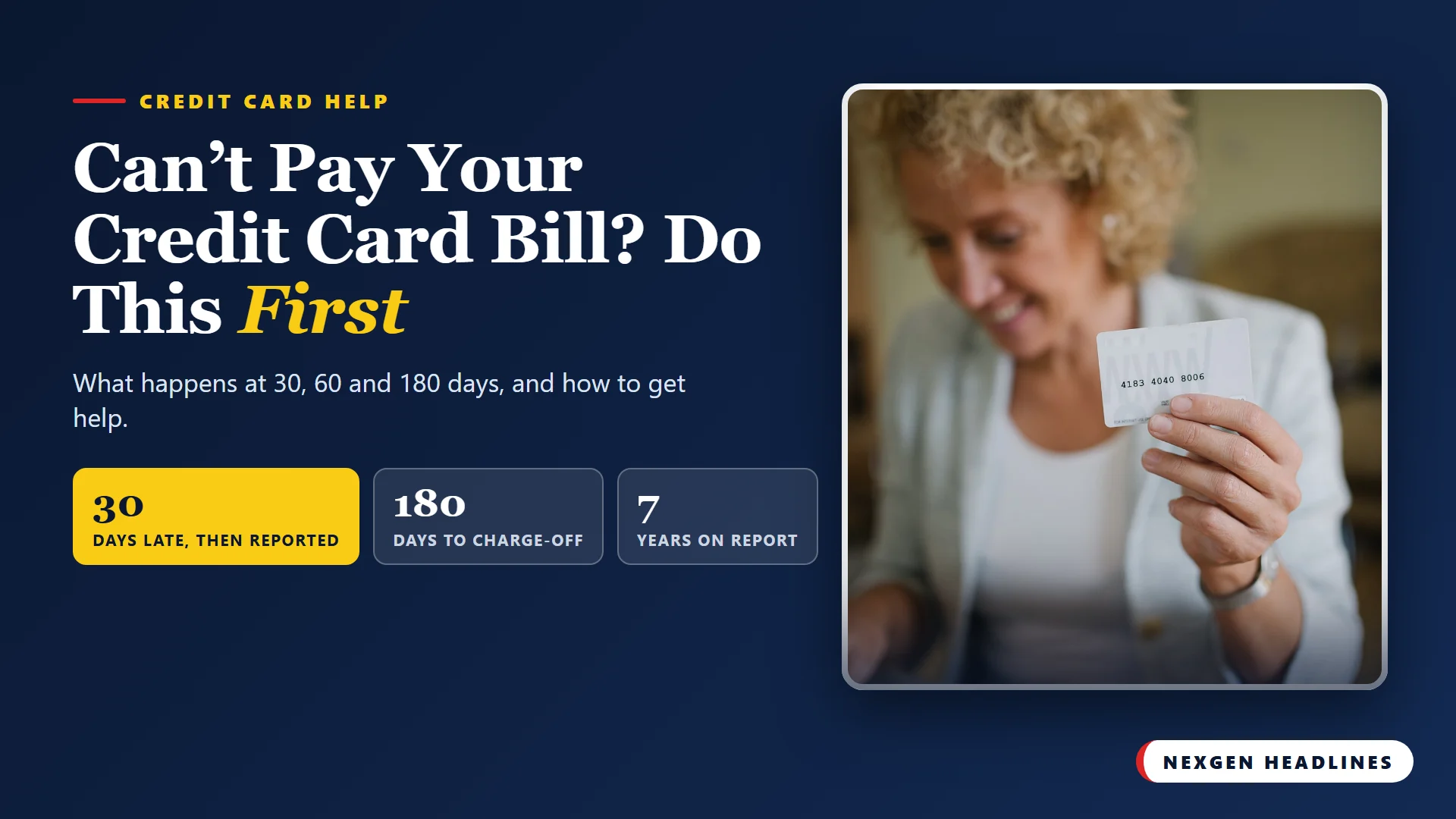

Quick answer: If you can’t pay your credit card bill, call your card issuer before the due date and ask about a hardship program. Pay at least the minimum if you can. A payment usually isn’t reported to the credit bureaus until it is 30 days late, so acting fast matters.
Missing one bill feels scary. But you have more options than most people think, especially in the first few weeks. Here is what happens, step by step, and what to do at each stage.
What happens when you miss a credit card payment
| How late | What usually happens | What you can still do |
|---|---|---|
| 1 day late | A late fee is charged. Any promo APR may be at risk under your card terms. | Pay right away and ask for the fee to be waived. |
| 30 days late | The issuer can report the late payment to Equifax, Experian and TransUnion. | Catch up before day 30 to keep it off your report. |
| 60 days late | The issuer may apply a penalty APR to your existing balance. | Ask about hardship plans and get current. |
| 90 to 150 days late | More calls and letters. The account may be closed to new charges. | Talk to a nonprofit credit counselor. |
| About 180 days late | The debt is usually charged off and may be sold to a collector. | You still owe it. Negotiate, and know your rights. |
Card terms differ, so check your cardholder agreement for exact fees and penalty rates. The 180-day charge-off point comes from federal bank regulators’ guidance for credit cards.
Step 1: Call your card issuer before the due date
This is the single most useful thing you can do. Card companies would rather get some money than none.
Use the number on the back of your card. Ask for the “hardship” or “financial assistance” department. Many big issuers have one, even if it is not on their website.
Say what changed, in one or two sentences. A job loss, a medical bill, a cut in hours. Then ask direct questions:
- “Do you have a hardship program I qualify for?”
- “Can you lower my interest rate for a few months?”
- “Can you waive this month’s late fee?”
- “Can you move my due date closer to my payday?”
Hardship plans are usually temporary, often a few months to a year. Some close the card to new charges while you are on the plan. Ask how the plan will show up on your credit report before you agree.
Write down the date, the name of the person you spoke with and what they promised. Ask them to send the terms in writing.
Step 2: Pay the minimum if you possibly can
The minimum payment keeps your account “current.” That means no late fee and no late mark on your credit report.
If you have several cards, the minimums together may be smaller than you think. Paying every minimum is better than paying one card in full and skipping others.
If you truly can’t pay even the minimums, put essentials first: housing, utilities, food, transportation to work and medicine. The CFPB gives the same advice. An unpaid credit card hurts your credit. An eviction or a shut-off hurts your life.
Step 3: Find money for the next payment
A short gap can sometimes be closed with a few quick moves:
- Cancel subscriptions you can live without for two months.
- Sell one thing you no longer use, like a spare phone or gaming console.
- Ask your employer about a payroll advance. Some offer it at no cost.
- Check for unclaimed money in your name on your state’s official site.
- Call other billers, like your phone or utility company, to ask for a payment plan, which frees up cash for the card.
Avoid payday loans and title loans to pay a credit card. Their fees often equal very high annual rates, and they can trap you in a cycle.
Also read: How to Build an Emergency Fund From Scratch
Step 4: Talk to a nonprofit credit counselor
If you are behind on more than one card, a nonprofit credit counselor can look at your whole budget for free or a low fee.
Many offer a debt management plan. You make one monthly payment to the agency. It pays your card companies, which often agree to lower interest rates or waive some fees.
Look for agencies that belong to the National Foundation for Credit Counseling (NFCC) or the Financial Counseling Association of America. The FTC warns that some companies pose as nonprofits and charge large fees, so ask about every fee up front.
Be careful with debt settlement companies. They often tell you to stop paying your cards while they negotiate. That can bring late fees, collection calls and serious credit damage, and there is no guarantee a deal will be reached.
What happens to your credit score
A payment that is 30 days or more late can lower your score, and the drop is often bigger if your score was high to begin with.
Under the Fair Credit Reporting Act, late payments and charge-offs can stay on your report for up to 7 years from the date you first fell behind. The good news: their effect fades over time, especially once you are paying on time again.
If a late payment is reported by mistake, you can dispute it with each credit bureau. Our guide on how to remove a late payment from your credit report walks through it.
A made-up example: two ways the same month can go
These are made-up examples to show how the timing works. They are not real people.
“Dana” works at a dental office in Ohio. Her hours were cut in September, and her $4,200 card balance has a $120 minimum due Oct. 15.
She calls her issuer on Oct. 10. The rep enrolls her in a six-month hardship plan with a lower interest rate and a $75 payment. Dana pays on time each month. Nothing late reaches her credit report.
“Marcus” has the same balance and the same problem. He waits, hoping things improve. By Nov. 15, he is 30 days late. He gets a late fee, a late mark on his credit report and, a month later, a penalty APR.
Same debt, same bad month. One phone call made the difference.
If your account goes to collections
After a charge-off, your card company may sell the debt to a collection agency. You still owe it, but you also have rights under the Fair Debt Collection Practices Act.
- Collectors must send you a validation notice showing the amount and who the creditor is.
- You can dispute the debt in writing, usually within 30 days of that notice.
- Under CFPB rules, collectors generally may not call you more than 7 times in 7 days about one debt.
- They cannot threaten arrest or use abusive language.
Collectors will often accept less than the full balance. Get any settlement in writing before you pay, and keep a copy.
Each state also has a statute of limitations on lawsuits over old debt, and the length varies by state. Making a payment on an old debt can restart that clock in some states, so read up or talk to a legal aid office first.
Common mistakes to avoid
- Ignoring the calls. Silence usually leads to more fees and fewer options.
- Paying a card with another card’s cash advance. Cash advances carry fees and high rates from day one.
- Raiding a 401(k). Early withdrawals can bring taxes and penalties, and retirement money is often protected from creditors.
- Agreeing to a payment you can’t keep. A broken plan can be worse than no plan.
- Trusting “debt relief” robocalls. Real nonprofit counselors don’t cold-call you with promises to erase debt.
When bankruptcy might be worth asking about
If your card debts are larger than you could repay in about five years, even on a tight budget, it may be worth a free consult with a bankruptcy attorney or legal aid office.
Bankruptcy is serious and stays on credit reports for years. But for some families it is the cleanest reset. You must take an approved credit counseling course before you file, which the U.S. Trustee Program lists on its website.
Recommended products
Simple tools that make bills easier to track:
- Monthly bill organizer planners
- Budget planner notebooks
- Cash envelope budgeting wallets
- Books on getting out of debt
Disclosure: As an Amazon Associate, Nexgen Headlines earns from qualifying purchases.
FAQ
Will one missed payment hurt my credit?
Not if you pay before it is 30 days late. Issuers generally report late payments to the credit bureaus only after that point. You may still owe a late fee.
Can my credit card company sue me?
Yes. A card issuer or debt buyer can sue over unpaid debt. If you are sued, respond by the court deadline. If you don’t, the court can enter a default judgment, which may allow wage garnishment in many states.
Does a hardship plan hurt my credit score?
The plan itself is not a late payment. But the issuer may close the card or add a note to your account, which can affect your score. Ask exactly how it will be reported before you agree.
Should I close the card I can’t pay?
Closing the card does not erase the balance. Focus on a payment plan first. The issuer may close or freeze the card as part of a hardship program anyway.
Bottom line
If you can’t pay your credit card bill, call before the due date, pay the minimum if you can, and protect rent, food and utilities first. A hardship plan or a nonprofit counselor can keep a bad month from turning into seven years of credit damage.
Last reviewed: Oct. 27, 2026. This guide is general information, not legal or financial advice.
Sources: Consumer Financial Protection Bureau: credit cards; FTC: How to get out of debt; CFPB Regulation F (debt collection); National Foundation for Credit Counseling; U.S. Trustee Program: credit counseling.
Featured image: Nenad Stojkovic / Wikimedia Commons, CC BY 2.0, edited by Nexgen Headlines.