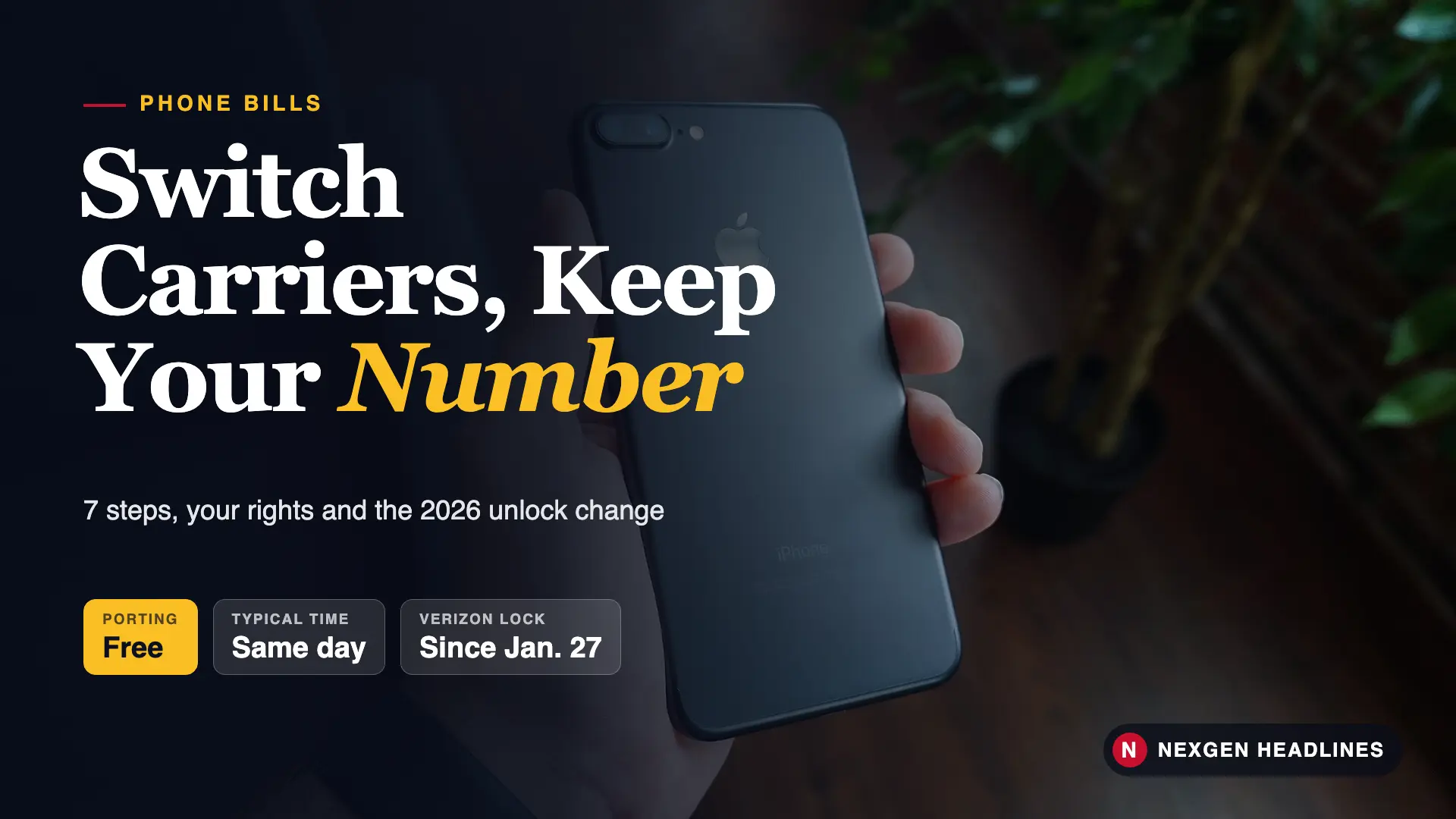

Quick answer: You can switch phone carriers and keep your number for free. Federal rules let you take your number with you, and your old carrier can’t refuse just because you owe it money. Before you switch, get your account number and a Number Transfer PIN from your current carrier, check that your phone is unlocked, and don’t cancel your old service first, or you could lose the number. Most switches finish the same day. One big 2026 change: Verizon phones bought on payment plans since Jan. 27, 2026, stay locked until paid off.
I’ve helped family members switch three times, and every hiccup came from skipping one of the steps below. Here’s the order that works.
How to switch carriers and keep your number: 7 steps
- Don’t cancel your current plan. Canceling first can release your number. The port itself ends your old service.
- Check whether your phone is unlocked (Settings on most phones, or ask your carrier). A locked phone only works on its original carrier.
- Check your device balance. If you’re paying off the phone, the rest of the balance usually comes due when you leave.
- Get your account number from your current carrier’s app or bill.
- Request a Number Transfer PIN. AT&T, T-Mobile and Verizon all issue a separate PIN for porting, usually in the app. It often expires within days.
- Sign up with the new carrier and choose “keep my number.” Enter the account number, PIN and the ZIP code on your account.
- Activate and test. Make a call, send a text and check data. Then confirm your old account shows as closed with a final bill.
What you need before you start
| Item | Where to find it |
|---|---|
| Account number | Carrier app, online account or paper bill |
| Number Transfer PIN | Requested in the app or by calling; separate from your account PIN at major carriers |
| Billing ZIP code | The address on your current account |
| Account holder’s name | Must match your current carrier’s records |
| Unlocked phone, or a new one | Check settings or ask your carrier |
Is my phone unlocked? The 2026 rules
A locked phone works only on the carrier that sold it. Unlock rules vary by carrier and changed this year.
- Verizon: For years, Verizon phones unlocked automatically after 60 days. The FCC granted Verizon a waiver on Jan. 12, 2026. For phones bought or activated on or after Jan. 27, 2026, a standard monthly Verizon phone generally stays locked until it’s paid in full. Older phones keep the old 60-day policy.
- Other carriers: Most require the phone to be paid off and the line active for a set period. Check your carrier’s unlock policy page.
- Bought outright from Apple, Google, Samsung or a store? Many unlocked models work on any major carrier.
Porting your number out doesn’t unlock your phone by itself. Request the unlock first if you qualify.
Also read: Cut Your Cell Phone Bill: 9 Ways to Save
Your rights when you switch
- You own the right to your number. FCC rules let you keep it when switching within the same area.
- An unpaid bill doesn’t block the port. Your old carrier can still bill you, but it can’t hold your number hostage.
- Carriers must protect you from port-out fraud. FCC rules adopted in 2023 require carriers to verify requests and notify you when someone tries to move your number. That’s why PINs exist.
- You can complain. If a carrier stalls, file a free complaint at fcc.gov/complaints.
What switching can cost
| Cost | What to know |
|---|---|
| Remaining phone balance | Usually due in full when you leave a payment plan |
| Lost bill credits | Promo credits that pay off a “free” phone stop when you leave |
| Activation fee at new carrier | Many charge one; some waive it online |
| Final bill | Partial month of service |
Many carriers now offer switching deals that pay off your old phone, usually as bill credits spread over 24 to 36 months. Read the fine print: if you leave early, the credits stop.
Made-up examples (not real people): These are made-up stories to show the math and the mistakes.
Gloria in Tampa pays $85 a month for one line. She switches to a prepaid plan for $30 a month and keeps her number. Her paid-off phone is unlocked, so the switch takes 20 minutes. She saves about $660 a year.
Jason in Denver cancels his old plan before signing up with a new carrier. His number is released, and he spends a week calling to get it back. If he’d ported first, it would have moved in an hour.
Switching to a cheaper prepaid or MVNO plan
Smaller carriers called MVNOs rent space on the big networks and often cost much less. Many run on AT&T, T-Mobile or Verizon towers, so coverage can be the same. Before you switch:
- Check coverage at your home, work and commute using the network the MVNO uses.
- Confirm your phone is compatible with the network and supports eSIM if the carrier uses it.
- Know the data limits. Cheaper plans may slow data after a cap or during busy times.
Switching a family plan
Moving several lines takes a bit more planning. The account holder usually has to request the transfer PIN, and each number can be ported together or one at a time.
- List every line with its number and whether the phone is paid off and unlocked.
- Move paid-off lines first if some phones still owe money, so you don’t pay off balances early unless the deal covers it.
- Keep the account open until the last line has ported; porting the final line closes it.
- Watch shared perks. Streaming bundles or hotspot add-ons tied to the old plan end when you leave.
When switching doesn’t make sense
- You owe a lot on a new phone and the new carrier won’t cover it.
- Coverage is weak where you live or work on the new network.
- You’re months away from a payoff. Waiting can save the bill credits you’d otherwise lose.
In those cases, call your current carrier first. Ask about a cheaper plan or a loyalty discount; mentioning a competitor’s price sometimes gets results without switching at all.
Common problems and fixes
- Port rejected: Usually a wrong account number, PIN or ZIP. Double-check them; PINs often expire after a few days.
- Calls work but texts don’t: On iPhone, turn iMessage off and on. Restart the phone.
- Port stuck for hours: Call the new carrier’s port-in team; most issues clear within a day.
- Two-factor codes stop: Codes go to your number, so they should keep working once the port completes. Keep backup codes for key accounts.
eSIM or physical SIM?
Most new phones support eSIM, a digital SIM you activate by scanning a QR code or through the carrier’s app. It’s faster than waiting for a SIM card in the mail, and you can often switch the same day from home. If your phone only takes a physical SIM, order the new carrier’s card first, then start the port when it arrives so you aren’t left without service.
Protect your number from scammers
Port-out scams let thieves move your number to their phone and grab bank codes. Set an account PIN, never share your Number Transfer PIN with anyone who calls you, and switch two-factor logins to an authenticator app where you can.
Recommended products
Disclosure: As an Amazon Associate, Nexgen Headlines earns from qualifying purchases.
FAQ
Can I keep my phone number if I switch carriers?
Yes. FCC rules let you take your number to a new carrier in the same area. Get your account number and Number Transfer PIN, and don’t cancel your old plan first.
Can my carrier refuse to release my number if I owe money?
No. Your old carrier can still bill you for what you owe, but it can’t block the number transfer.
How long does it take to port a number?
Most wireless ports finish within hours, often minutes. Some take up to a day.
Are Verizon phones still unlocked after 60 days?
Not for phones bought or activated on or after Jan. 27, 2026. Those standard monthly phones generally stay locked until paid in full. Older phones keep the 60-day policy.
Should I cancel my old plan before switching?
No. Canceling first can release your number. Let the port close your old account.
Bottom line
Switching carriers and keeping your number is free and usually quick if you do it in order: check the unlock, get your account number and transfer PIN, sign up with the new carrier, then let the port close the old account. Watch your phone balance and bill credits so a cheaper plan stays cheaper.
Last reviewed: Oct. 30, 2026.
Sources: FCC: Keeping your number; Android Authority: Verizon unlock change; Nelson Mullins: FCC waiver (Jan. 2026); FCC: Cell phone unlocking; FCC complaints.
Featured image: A smartphone in hand. Photo: Dennis Cortés / Unsplash via Wikimedia Commons, CC0; edited by Nexgen Headlines.