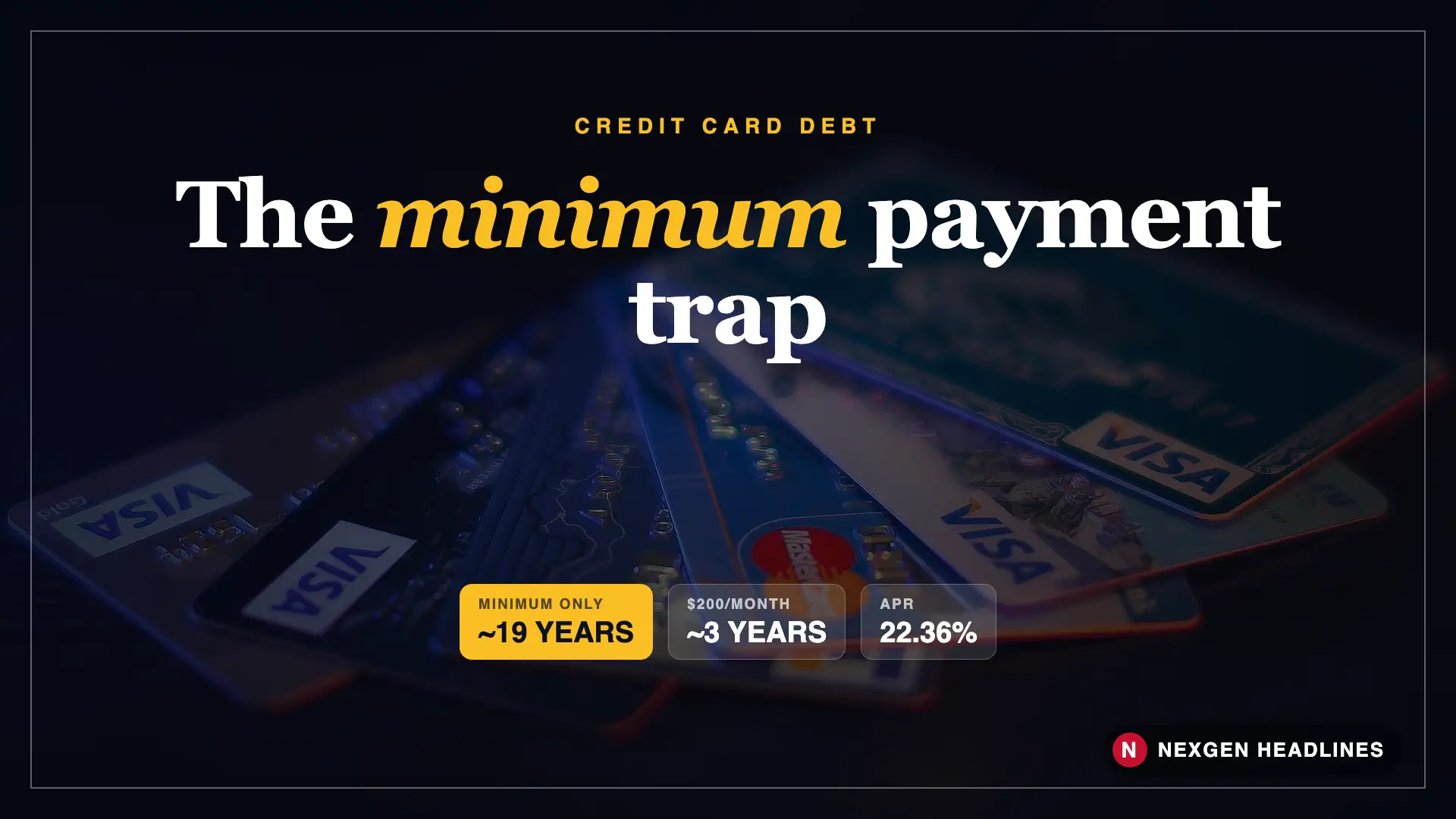

Quick answer: If you only make the minimum payment, a $5,000 credit card balance at 22.36% APR can take about 19 years to pay off and cost around $8,200 in interest (our estimate, using a common minimum formula). Paying a fixed $200 a month instead clears it in about 3 years with roughly $1,800 in interest. Your statement must show your own payoff time under the federal CARD Act.
Minimum payments are designed to keep you current, not to get you out of debt. Most of each minimum goes to interest. Here’s how minimums are calculated, how long they really take, and simple ways to pay less.
Minimum payment vs. fixed payment: the numbers
| Balance (22.36% APR) | Minimum only | Fixed $200/month | Fixed $300/month |
|---|---|---|---|
| $3,000 | ~15 years, ~$4,500 interest | ~18 months, ~$550 interest | ~12 months, ~$350 interest |
| $5,000 | ~19 years, ~$8,200 interest | ~34 months, ~$1,800 interest | ~21 months, ~$1,040 interest |
| $10,000 | ~25 years, ~$17,600 interest | ~12 years, ~$19,000 interest | ~53 months, ~$5,800 interest |
Nexgen Headlines estimates. “Minimum” assumes interest plus 1% of the balance, or $25, whichever is more. 22.36% was the average rate on card accounts charged interest in August 2026 (Federal Reserve). Your card’s formula and rate may differ.
Notice the $10,000 row: $200 a month barely beats the interest, so it takes 12 years. On big balances, you need a much larger payment or a lower rate.
How credit card minimum payments are calculated
Each issuer sets its own formula in your card agreement. The most common ones are:
- Interest + fees + 1% of the balance, with a floor like $25 or $35.
- A flat percentage of the balance, often 2% to 3%, with a floor.
As your balance drops, so does the minimum. That’s why paying only the minimum stretches the debt out for decades.
Find your real payoff time in 2 minutes
- Open your latest statement. Look for the “Minimum Payment Warning” box.
- Read the two numbers. The CARD Act requires issuers to show how long payoff takes with minimums only, and the total cost.
- Find the “3-year” line. Statements also show the monthly payment needed to pay it off in about 3 years, and how much you’d save.
- Set that amount as autopay if you can afford it.
- Recheck every few months as your balance and rate change.
Made-up example (for illustration):
Carlos has $5,000 on a card at 22.36%. His minimum is about $143 this month (interest of about $93 plus 1% of the balance). He pays exactly that every month. Years later, he’s still paying.
His sister Ana has the same balance and rate. She sets autopay to $200 and never changes it. She’s debt-free in under 3 years and pays about $6,400 less in interest than Carlos (estimate).
Also read: How to lower your credit card interest rate
Why the minimum is a trap
- Most of it is interest. In early months, often two-thirds of the minimum goes to interest.
- The minimum shrinks as you pay. So your payoff slows down, not speeds up.
- New purchases make it worse. If you keep charging, the balance may never fall.
- High utilization hurts your credit score. Large balances relative to your limit can lower your score.
7 ways to pay off cards faster
- Pay a fixed amount instead of the minimum, even $25 or $50 more helps.
- Ask for a lower APR. One phone call can cut your rate.
- Use a 0% balance transfer card if you qualify. Watch the 3% to 5% transfer fee and pay it off before the intro period ends.
- Try the avalanche method: pay extra on the highest-rate card first. It saves the most interest.
- Or the snowball method: pay off the smallest balance first for quick wins and motivation.
- Pay twice a month. Splitting your payment can reduce the average daily balance a little and keeps you on track.
- Stop new charges on the card you’re paying down. Use debit or cash for a while.
What if you can’t afford more than the minimum?
Paying the minimum on time is still far better than missing a payment. A late payment can bring a fee, a penalty APR and a hit to your credit score. If you’re struggling:
- Call your issuer and ask about a hardship program with a lower rate or payment.
- Contact a nonprofit credit counselor (look for NFCC members) about a debt management plan.
- Be careful with debt settlement companies; the FTC warns about upfront fees and credit damage.
- Look at your budget for one or two bills you can cut, and send that money to the card.
Minimum payment and your credit score
Paying the minimum on time protects your payment history, the biggest part of your FICO score. But it doesn’t help much with credit utilization, the share of your limits you’re using. Keeping utilization under 30%, and ideally under 10%, can help your score. Paying down balances is the fastest way to lower it.
Mistakes to avoid
- Setting autopay to “minimum due” and forgetting about it.
- Closing paid-off cards right away, which can raise your utilization.
- Moving debt to a balance transfer card and charging the old card again.
- Taking cash advances, which usually carry higher rates and fees with no grace period.
Avalanche vs. snowball: which saves more?
| Method | Pay extra on | Best for |
|---|---|---|
| Avalanche | Highest interest rate first | Saving the most money |
| Snowball | Smallest balance first | Staying motivated with quick wins |
The avalanche method usually costs less in interest. The snowball method can work better if you need early wins to stick with the plan. The best method is the one you’ll keep doing every month.
A simple 3-step plan for this month
- List every card with its balance, APR and minimum payment.
- Find one extra amount you can pay each month, even $50, by trimming one expense like a streaming service or eating out.
- Set autopay for the minimum on all cards plus your extra amount on your target card.
When one card is paid off, roll its whole payment into the next card. That “rollover” is what speeds things up over time.
When a debt consolidation loan makes sense
If you have good credit, a personal loan at a lower fixed rate can replace several high-rate card balances with one payment and a clear end date. It only helps if the new rate is lower and you stop adding new card debt. Compare the loan’s APR, including any origination fee, with your current card rates.
What your statement’s warning box looks like
Under the CARD Act, your monthly statement includes a box titled something like “Minimum Payment Warning.” It shows how long it would take to pay off your balance with minimum payments only, the estimated total you’d pay, and the payment needed to pay it off in about 3 years, plus the savings. It also lists a phone number for credit counseling. Use it as your starting point.
Finally, keep one small emergency fund, even $500, so a surprise bill doesn’t go back on the card. Many people get stuck because every emergency adds new debt while they’re trying to pay old debt down.
If you get a raise, bonus or tax refund, send part of it to your highest-rate card right away. Even one extra lump sum can shave months off your payoff.
Recommended products
Tools that help you stay on a payoff plan.
Disclosure: As an Amazon Associate, Nexgen Headlines earns from qualifying purchases.
FAQ
Is it bad to only pay the minimum on a credit card?
It keeps your account current, but it can take decades and cost thousands in interest. Pay more whenever you can.
How is my minimum payment calculated?
It depends on your card agreement. Many use interest plus 1% of the balance, or a flat 2% to 3%, with a dollar floor.
Where can I see how long my payoff will take?
On your monthly statement, in the minimum payment warning box required by the CARD Act.
Does paying more than the minimum help my credit?
Yes, indirectly. Lower balances mean lower utilization, which can raise your score.
What’s the fastest way to pay off credit card debt?
Pay as much as you can toward the highest-rate card while paying minimums on others, and cut your rate with a call or a 0% transfer.
Bottom line
Paying only the minimum on a $5,000 balance can take about 19 years. A fixed $200 a month cuts that to about 3 years and saves thousands. Check the warning box on your statement, set a fixed autopay amount, and attack the highest-rate card first.
Last reviewed: Nov. 12, 2026. Payoff numbers are Nexgen Headlines estimates, not offers.
Sources: CFPB: Credit cards, CFPB: Regulation Z §1026.7 (minimum payment disclosures), FRED: Credit card rates on accounts assessed interest, FTC: How to get out of debt, NFCC.
Featured image: Credit cards. Photo: Yuri Samoilov / Wikimedia Commons, CC BY 2.0; edited by Nexgen Headlines.