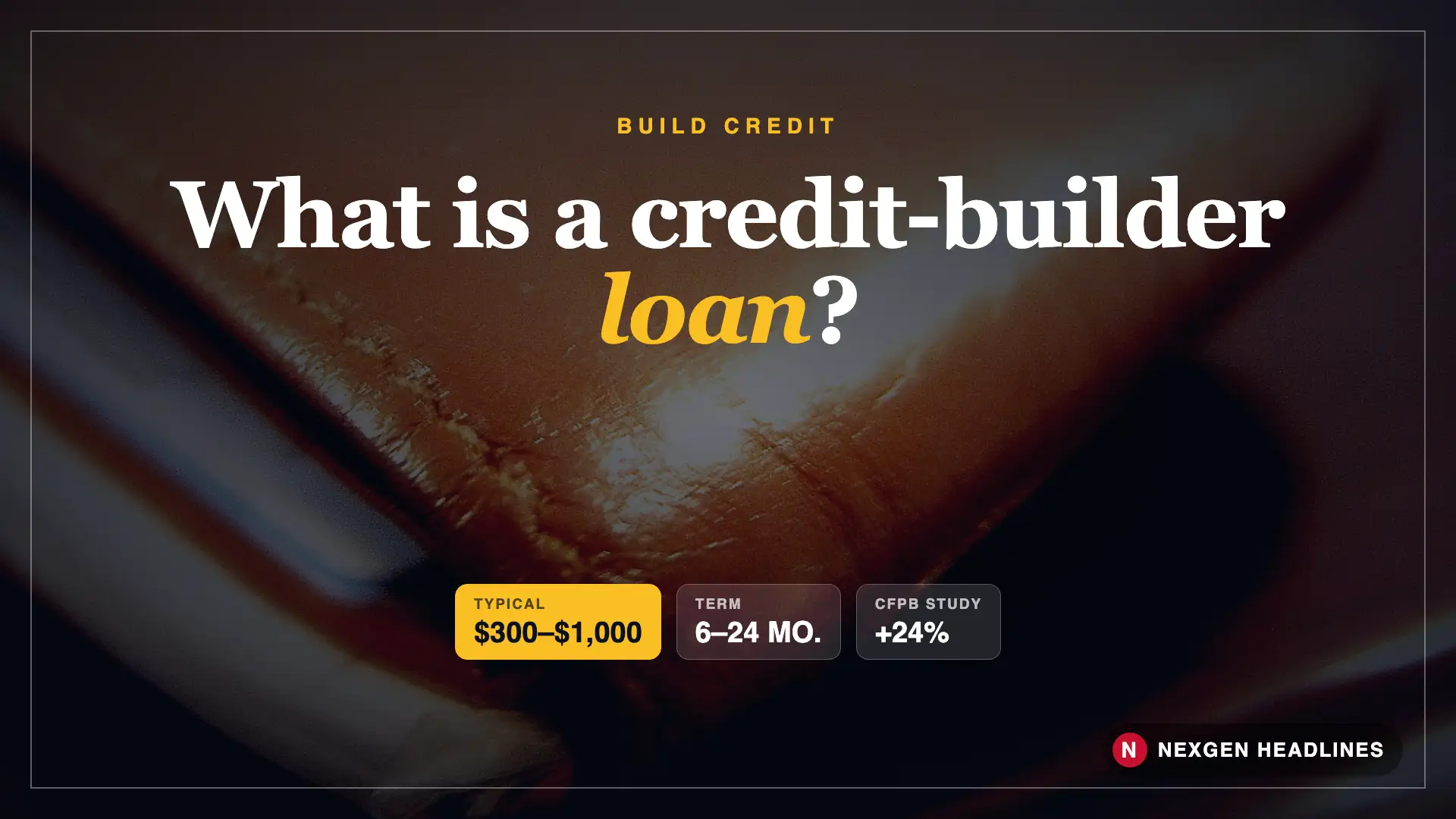

Quick answer: A credit-builder loan is a small loan that helps you build a credit history. Instead of handing you the money, the lender locks it in a savings account or CD. You make monthly payments, the lender reports them to the credit bureaus, and you get the money (minus interest and fees) when the loan is paid off. The CFPB says these loans are often $300 to $1,000 over 6 to 24 months.
It’s a “save first, borrow later” setup. It can work well if you have no credit or thin credit. It can backfire if you miss payments. Here’s how to decide.
Credit-builder loan at a glance
| Question | Answer |
|---|---|
| Typical amount | $300 to $1,000 (some lenders go higher) |
| Typical term | 6 to 24 months |
| When you get the money | At the end, after the last payment |
| Costs | Interest (APR), sometimes an admin fee, late fees |
| Credit check | Often none or a soft check |
| Reports to | Usually Equifax, Experian and TransUnion (confirm first) |
| Where to get one | Credit unions, community banks, CDFIs, some online lenders |
| Best for | No credit, thin credit, or rebuilding after mistakes |
How a credit-builder loan works, step by step
- You apply. Many lenders don’t require good credit. Some check your bank history instead.
- The lender sets aside the loan amount. For example, $600 goes into a locked savings account or CD in your name.
- You make fixed monthly payments. Each payment covers part of the principal plus interest.
- The lender reports your payments to the credit bureaus every month.
- You finish the term. The lender releases the money. Some lenders also pay you interest earned on the locked account.
Because the loan is backed by your own money, the lender takes very little risk. That’s why approval is easier than for a credit card or personal loan.
How it can help your credit score
FICO scores weigh payment history most heavily, about 35% of the score. A credit-builder loan adds a monthly on-time payment to your report.
It can also help your credit mix, because it’s an installment loan. If you only have credit cards, that can be a small plus.
The CFPB studied these loans in 2020. It found they helped most for people with no existing debt. Participants without an existing loan were 24% more likely to establish a credit score. But for people who already had debt, the benefit was smaller, and many missed payments.
The risk: late payments hurt
A credit-builder loan reports bad news as well as good. A payment that’s 30 days late can be reported and pull your score down.
In the CFPB study, many participants fell behind on payments. So be honest about your budget before you sign. If the payment is a stretch, a secured credit card with a tiny balance may be safer.
Made-up examples (for illustration):
Jasmine, 22, has no credit history. She takes a $600, 12-month credit-builder loan from her credit union at a $52 monthly payment. She sets up autopay and never misses. After a year, she has a year of on-time payments on all three reports and gets about $600 back, which she keeps as an emergency fund. Her total cost: roughly the interest and a small fee.
Carlos, 38, already juggles two credit cards near their limits. He adds a credit-builder loan but misses two payments when money gets tight. Those late marks hurt his score more than the loan helped. Paying down his card balances would have been a better first step.
What does a credit-builder loan cost?
Costs depend on the lender. Common ones include:
- Interest (APR). Credit unions often charge low rates. Some online lenders charge more.
- Administrative or setup fee. Some charge one; some don’t.
- Late fees if you miss a due date.
- Early payoff rules. Some let you pay off early; others don’t, and paying early may not help your credit as much as steady payments.
Some lenders refund part of the interest at the end, or pay interest on the locked savings. Ask for the total cost in dollars before you sign.
Also read: How to raise your credit score
How to get a credit-builder loan
- Start with your bank or credit union. Many credit unions offer them with low rates. You may need to join first.
- Check community lenders. Community development financial institutions (CDFIs) and some nonprofits offer them too.
- Compare online lenders if local options aren’t available. Read reviews and fee tables closely.
- Confirm bureau reporting. Ask which bureaus they report to. All three is best.
- Pick a payment you can afford every month, even in a tight month.
- Set up autopay from your checking account.
- Check your credit reports after two or three months at AnnualCreditReport.com to confirm payments show up.
Credit-builder loan vs. other ways to build credit
| Option | How it works | Upfront cash? | Watch out for |
|---|---|---|---|
| Credit-builder loan | Pay first, get money at the end | No | Late payments, fees |
| Secured credit card | Deposit sets your credit limit | Yes, the deposit | High utilization, annual fees |
| Authorized user | Added to someone’s card | No | Their late payments can hurt you |
| Rent or bill reporting | Services report on-time rent or utility bills | Sometimes a fee | Not every score model counts it |
| Student or starter card | Small-limit unsecured card | No | Easy to overspend |
Many people use two together, such as a credit-builder loan and a secured card kept at a low balance.
Who should (and shouldn’t) get one
Good fit:
- Young adults or new arrivals with no credit file.
- People rebuilding after collections or bankruptcy who now have a stable budget.
- Anyone who wants to save and build credit at the same time.
Not a good fit:
- You need cash now. You won’t get the money until the end.
- Your budget is already tight or you’re behind on other bills.
- You already have a solid credit history. The gain will be small.
A simple 12-month plan
- Month 1: Pull your free credit reports at AnnualCreditReport.com and fix any errors.
- Month 1: Open a small credit-builder loan at a credit union and turn on autopay.
- Month 3: Check that the loan appears on your reports with on-time payments.
- Month 6: If your budget allows, add a secured card. Use it for one small bill and pay it in full.
- Month 12: Collect your savings when the loan ends. Keep it as an emergency fund.
Steady, boring payments are what build credit. There’s no shortcut, and anyone selling one is a red flag. The FTC warns that “credit repair” companies can’t legally remove accurate negative information from your report.
Questions to ask the lender before you sign
- What is the APR, and what is the total cost in dollars over the full term?
- Is there a setup or administrative fee? Is any of it refundable?
- Which credit bureaus do you report to, and how often?
- What happens if I pay late or want to pay off early?
- Do I earn interest on the money held in savings?
Common mistakes
- Borrowing more than you can repay. A smaller loan works just as well for credit.
- Not checking bureau reporting. If it doesn’t report, it doesn’t help.
- Skipping autopay and missing a due date.
- Ignoring fees. Compare total cost, not just the monthly payment.
- Expecting a fast jump. Building credit takes months of steady payments.
Recommended products
Simple tools that help you never miss a payment.
Disclosure: As an Amazon Associate, Nexgen Headlines earns from qualifying purchases.
FAQ
How much can a credit-builder loan raise my score?
There’s no fixed number. It depends on your starting file. People with no credit history usually see the biggest change, after several months of on-time payments.
Do credit-builder loans require a credit check?
Many don’t, or use only a soft check. Some look at your bank account history instead.
Can I get my money early?
Usually not until the loan is paid off. Some lenders allow early payoff; ask before you sign.
Is a credit-builder loan better than a secured card?
Neither is always better. A loan needs no deposit; a secured card adds revolving credit. Many people use both.
What happens if I stop paying?
Late payments get reported, and the lender may close the loan and use the locked savings to cover what you owe.
Bottom line
A credit-builder loan is a low-risk way to build credit and savings together, as long as you pay on time every month. Start with a credit union, choose a small amount, confirm it reports to all three bureaus, and turn on autopay. In 6 to 24 months, you’ll have a payment history and a small savings cushion.
Last reviewed: Nov. 23, 2026. Loan terms and fees vary by lender; confirm before you apply.
Sources: CFPB: Credit builder loans practitioner guide (2020), CFPB study on credit-builder loans, myFICO: What’s in your credit score, Experian, AnnualCreditReport.com.
Featured image: Leather wallet. Photo: Saad Akhtar / Wikimedia Commons, CC BY 2.0; edited by Nexgen Headlines.