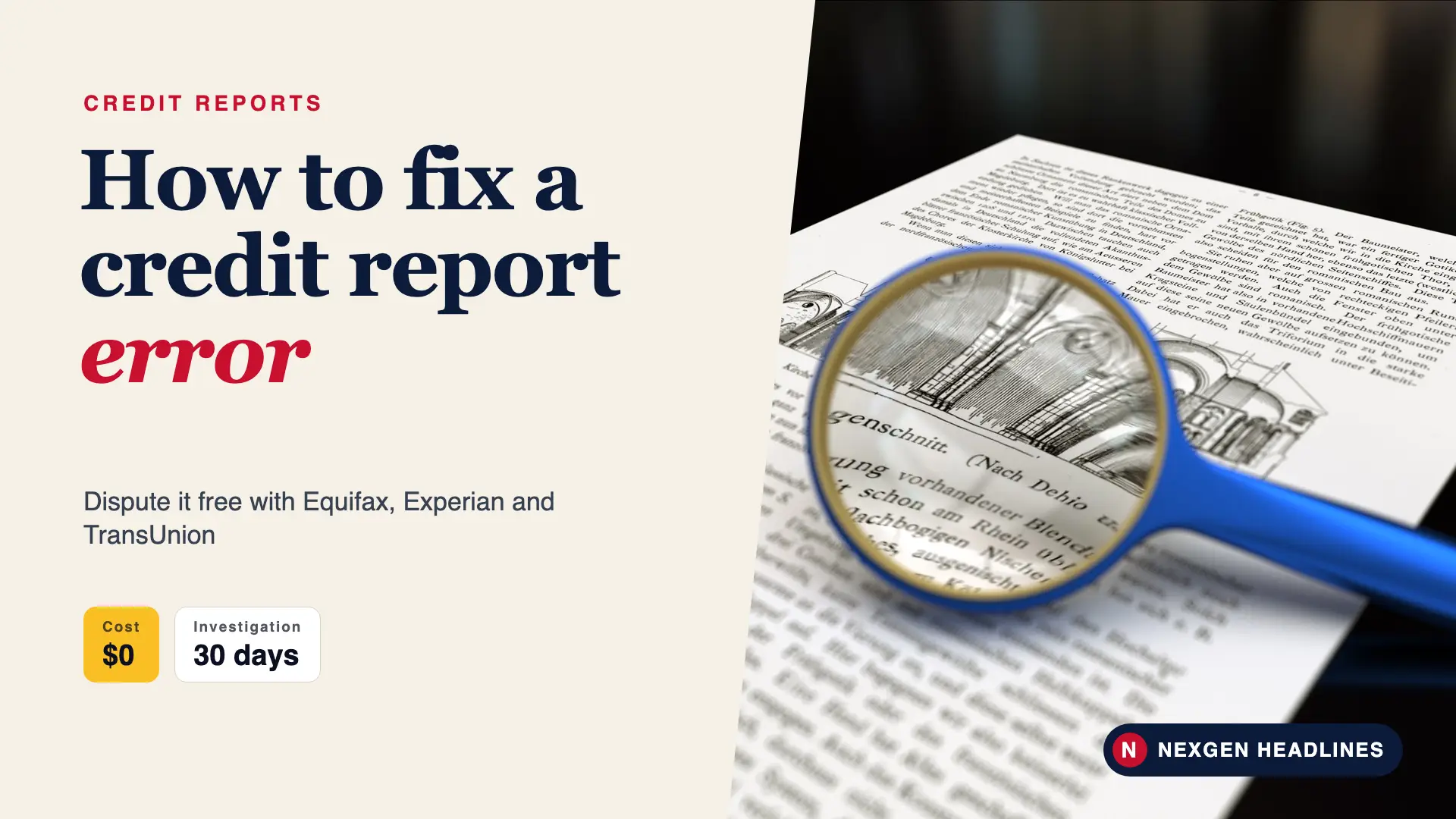

Quick answer: To fix a credit report error, get your free report at AnnualCreditReport.com, then file a dispute with each bureau that shows the error: Equifax, Experian or TransUnion. It’s free. The bureau generally has 30 days to investigate. Also dispute directly with the company that reported it.
Credit report mistakes are common. A wrong late payment, an account that isn’t yours or a debt listed twice can lower your score and cost you money on loans. The good news: federal law gives you the right to fix them for free.
Credit report dispute at a glance
| Question | Answer |
|---|---|
| Cost | $0 |
| Law that protects you | Fair Credit Reporting Act (FCRA) |
| Where to get reports | AnnualCreditReport.com, free every week |
| Who to dispute with | Each bureau showing the error, and the company that reported it |
| Investigation time | Generally 30 days; can be up to 45 days in some cases |
| Results notice | Within 5 business days after the investigation ends |
| Accurate negative info | Most stays up to 7 years; some bankruptcies 10 years |
How to dispute a credit report error in 7 steps
- Get all three reports for free at AnnualCreditReport.com. Errors can show on one bureau but not the others.
- Mark every error. Circle or note the account name, number and what’s wrong.
- Gather proof. Bank statements, payment confirmations, letters or an identity theft report.
- File a dispute with each bureau that shows the error: online, by mail or by phone.
- Explain clearly. Say what’s wrong and what the fix should be, like “This late payment for March 2026 is wrong. I paid on time.”
- Dispute with the furnisher too. That’s the bank, lender or collector that sent the information.
- Save everything. Keep copies, confirmation numbers and dates.
Common credit report errors to look for
| Type of error | Example |
|---|---|
| Identity mistakes | Wrong name, address or Social Security number |
| Accounts that aren’t yours | Mixed with someone with a similar name, or opened by a thief |
| Wrong payment history | A payment shown late when it was on time |
| Wrong balance or limit | An old balance, or a credit limit listed too low |
| Duplicate debts | The same debt listed twice, sometimes under a collector too |
| Wrong status | A closed account shown open, or a paid debt shown unpaid |
| Old information | Negative items past the legal time limit |
Wrong credit limits matter more than you might think. A low limit makes your credit utilization look higher, which can pull down your score.
How to file with each bureau
- Equifax: file online through your myEquifax account, or by mail or phone.
- Experian: use the dispute center at experian.com/disputes.
- TransUnion: use the dispute center at transunion.com/credit-disputes.
Online disputes are fastest. But a mailed letter gives you a clear paper trail. If you mail it, use certified mail with return receipt.
Some bureau websites show a checklist of reasons. Pick the closest one, then add your own short explanation and upload proof.
What to put in a dispute letter
The CFPB offers free sample dispute letters. A good letter includes:
- Your full name, address and date of birth
- A copy of the report with the error circled
- Each item you’re disputing and why it’s wrong
- What you want done: removed or corrected
- Copies (never originals) of your proof
Keep it short and factual. You don’t need a lawyer or special words. Sign and date the letter, and keep a copy of everything you send. If you call instead, write down the date, the name of the person you spoke with and your confirmation number.
Made-up example: fixing a wrong late payment
This is a made-up example to show how a dispute might go. It is not a real person.
Robert checks his free reports before applying for a mortgage. Experian shows a 30-day late payment on his auto loan for June. He paid on time and has the bank statement to prove it.
He files a dispute online with Experian and uploads the statement. He also sends a letter to his auto lender. Three weeks later, Experian removes the late mark. His score rises before his mortgage application.
What happens after you dispute
- The bureau sends your dispute and documents to the company that reported the information.
- That company must investigate and report back.
- If the information is wrong or can’t be verified, it must be corrected or deleted.
- The bureau must send you the results in writing within 5 business days after it finishes.
- If the report changes, you get a free copy of the updated report.
If the item is changed, you can ask the bureau to send the corrected report to anyone who checked your credit in the last six months, or the last two years for employment.
Also read: How to Remove a Late Payment From Your Credit Report
What if the bureau says the information is correct?
Don’t give up. You still have options:
- Dispute with the furnisher directly. Send proof to the lender or collector. It must investigate too.
- Add a statement of dispute. You can ask the bureau to add a short explanation to your file.
- Send new proof. If you find more documents, file a new dispute.
- File a complaint with the CFPB at consumerfinance.gov/complaint.
- Talk to a consumer attorney. FCRA cases sometimes allow you to recover damages and legal fees.
What you can’t remove
A dispute can fix errors. It can’t remove accurate information just because it hurts. Under the FCRA:
- Most accurate negative items, like late payments and collections, can stay up to 7 years.
- Some bankruptcies can stay up to 10 years.
Companies that promise to remove accurate negative information are making promises the law doesn’t support. The FTC warns about credit repair scams.
Watch out for credit repair scams
Under the federal Credit Repair Organizations Act, credit repair companies can’t charge you before they do the work. Red flags include:
- Asking for money up front
- Promising to remove accurate negative items
- Telling you not to contact the bureaus yourself
- Suggesting you create a “new identity” with a different number
Everything a legitimate company can do, you can do yourself for free.
Disputes caused by identity theft
If accounts on your report were opened by a thief, use the special identity theft process:
- Report it at IdentityTheft.gov to get an FTC Identity Theft Report.
- Send the report to each bureau and ask them to block the fraudulent accounts.
- Place a credit freeze or extended fraud alert.
- Contact each company where a fake account was opened.
Bureaus generally must block information resulting from identity theft once you send the proper documents.
Medical debt on your credit report
Medical collections follow special rules set by the three bureaus in 2022 and 2023:
- Paid medical collections are removed from credit reports.
- Medical collections under $500 aren’t reported.
- Unpaid medical collections wait at least one year before they can appear.
If you see a medical collection that breaks these rules, dispute it. Also check the bill itself. Insurance may still owe part of it, or you may qualify for the hospital’s financial assistance program.
Sample dispute wording you can copy
Keep your explanation to a few sentences. Here are simple examples you can adapt:
- Wrong late payment: “The [lender] account ending in 1234 shows a 30-day late payment for March 2026. I paid on March 3, before the due date. My bank statement is attached. Please correct the payment history.”
- Not my account: “I never opened the [company] account ending in 5678. I did not authorize it. Please delete it. My FTC Identity Theft Report is attached.”
- Paid debt shown unpaid: “The [collector] account shows a $640 balance. I paid it in full on July 10, 2026. The paid-in-full letter is attached. Please update the balance to $0.”
- Duplicate: “The same debt appears twice, under [original creditor] and [collector]. Please correct the report so it’s listed only once with the right balance.”
Other reports worth checking
The three big bureaus aren’t the only ones keeping files on you. Specialty reporting companies collect data for banks, landlords, insurers and employers. You can usually get a free copy of these reports once a year and dispute errors the same way:
- ChexSystems: checking account history, used by many banks
- Tenant screening companies: used by landlords
- Insurance claims databases: used for home and auto insurance quotes
- Employment background screeners: used by some employers
The CFPB keeps a list of consumer reporting companies with links to request your files.
How long until my score improves?
Once an error is fixed, your report updates. Your score uses the new data the next time it’s calculated. Many people see changes within a few weeks after the dispute closes.
If you’re applying for a mortgage soon, ask your loan officer about a rapid rescore. Lenders can sometimes request a faster update when you have proof of a correction.
How often should I check my credit reports?
You can check all three reports for free every week at AnnualCreditReport.com. A good habit for most people:
- Check all three reports at least every few months
- Check before any big application: mortgage, car loan or apartment
- Check right away after a data breach letter or lost wallet
Checking your own report never hurts your score.
Common mistakes when disputing
- Disputing everything at once, including accurate items. It can slow the process.
- Sending originals. Always send copies.
- Skipping the furnisher. Disputing with both gives you more protection.
- Not keeping records. Save every letter and confirmation number.
- Paying a company to do it. Disputes are free.
- Ignoring the results letter. Read it to see what changed.
Recommended products
Simple tools to keep your credit paperwork organized.
Disclosure: As an Amazon Associate, Nexgen Headlines earns from qualifying purchases.
FAQ
Does disputing a credit report hurt my score?
No. Filing a dispute doesn’t lower your score. If an error is removed, your score may go up.
How long does a credit report dispute take?
Bureaus generally have 30 days to investigate. It can be up to 45 days in some cases, such as when you send more information during the investigation.
Should I dispute online or by mail?
Online is usually faster. Mail gives you a stronger paper trail. Either way, keep copies.
Can I dispute a collection account?
Yes, if it’s wrong: not your debt, the wrong amount, already paid or too old to report.
Do I need to dispute with all three bureaus?
Only with the bureaus that show the error. Check all three reports to find out.
Can I dispute a hard inquiry?
Yes, if you didn’t authorize it. An inquiry you didn’t apply for can be a sign of identity theft. Dispute it with the bureau and contact the company that pulled your report. Inquiries you did authorize are accurate and usually stay for two years, though they generally affect scores only a little.
What if the error comes back after it was removed?
Under the FCRA, information deleted after a dispute generally can’t be put back unless the company certifies it’s accurate, and the bureau must notify you within five business days. If an error reappears, dispute it again with your earlier results letter attached, and consider a CFPB complaint.
Bottom line
You have a legal right to an accurate credit report, and fixing errors costs nothing. Pull all three reports, dispute each mistake with the bureau and the company that reported it, send proof and keep records. If that fails, the CFPB is there to help.
Last reviewed: Nov. 6, 2026.
Sources: CFPB: Credit reports and scores, FTC: Disputing errors on your credit reports, FTC: Fair Credit Reporting Act, FTC: Fixing your credit FAQs, AnnualCreditReport.com.
Featured image: Photo: Niabot / Wikimedia Commons, CC BY-SA 3.0; edited by Nexgen Headlines.