Trump Taxpayer Funded Video
Trump Taxpayer Funded Video Creates New Washington Storm
Trump Taxpayer Funded Video is at the center of a growing national debate after the White House began airing a dramatic 30-second television advertisement featuring President Donald Trump declaring that America is facing a “final battle” against political and ideological opponents.
- Trump Taxpayer Funded Video
- Trump Taxpayer Funded Video Creates New Washington Storm
- A Dramatic ‘Final Battle’ Message
- The 2024 Campaign Connection
- White House Defends the Advertisements
- Bipartisan Criticism Grows
- How Much Has Been Spent?
- Earlier Government-Funded Ads
- Why the Timing Matters
- Federal Rules on Government Propaganda
- Why the Agency Matters
- Supporters See a Patriotic Message
- Critics Focus on Trump’s Personal Image
- The Strongman Image
- The Role of the ‘Fake News’ Media Reference
- Could There Be an Investigation?
- A Debate Bigger Than One Advertisement
- What Happens Next?
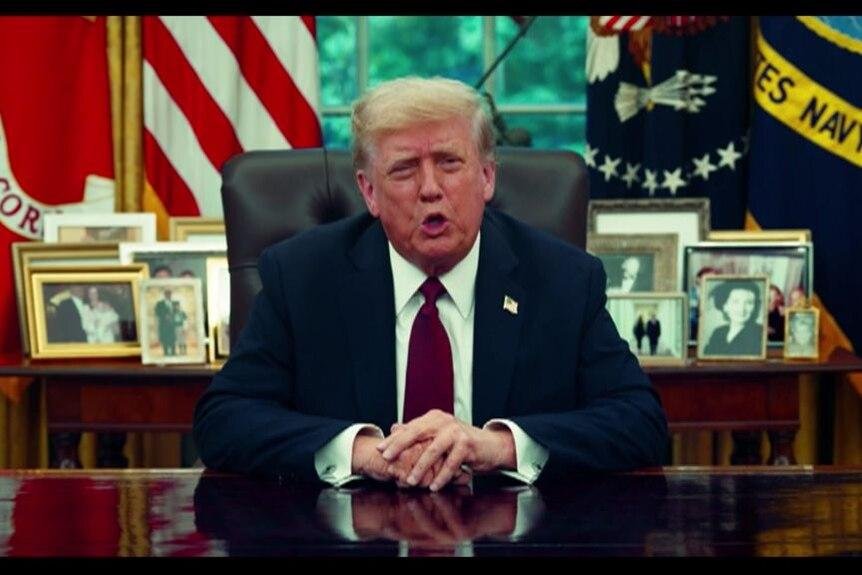
The black-and-white commercial shows Trump walking down a hallway lined with presidential portraits while audio from an earlier speech plays over the footage. The advertisement ends with the disclosure: “Paid for by the U.S. Government.”
The commercial has attracted criticism from lawmakers in both parties and government-ethics advocates, who are questioning whether taxpayer money should be used for an advertisement that closely resembles Trump’s 2024 presidential campaign material.
The White House, however, says the spots are legitimate public service announcements rather than campaign advertisements.
The dispute has become particularly significant because the advertisements are airing only weeks before the November 2026 midterm elections.
A Dramatic ‘Final Battle’ Message
The Trump Taxpayer Funded Video uses a highly dramatic presentation.
Trump is shown walking directly toward the camera as his voice describes what he calls a “final battle.”
The audio includes references to the “deep state,” “warmongers,” “globalists,” communists, Marxists and fascists. Trump also attacks what he calls the “fake news media” and says he will “liberate America” from his political opponents.
The imagery is deliberately simple: black-and-white footage, a presidential setting and Trump’s voice dominating the soundtrack.
That style closely resembles political campaign advertising.
The commercial is also notable because much of the footage and language comes from material Trump used during his 2024 presidential campaign.
The 2024 Campaign Connection
One of the most important details behind the controversy is the similarity between the government-funded advertisement and an earlier Trump campaign video.
The 2024 version included nearly identical footage and rhetoric. However, the campaign version ended with a direct political message encouraging viewers to join Trump’s fight for America.
The current government-funded version removes that campaign ending and instead includes the disclosure that it was paid for by the U.S. government.
That change has become central to the debate.
Critics say replacing a campaign logo with a government funding disclosure does not necessarily transform campaign-style material into a conventional public-service announcement.
The White House takes a different position, arguing that the current advertisements communicate patriotic and educational messages rather than asking voters to support Trump at the ballot box.
White House Defends the Advertisements
Administration officials have defended the Trump Taxpayer Funded Video campaign.
The White House has described the advertisements as public-service announcements and argues that Trump is not currently on the ballot.
Officials have also compared the spending with government advertising conducted by previous presidential administrations.
The administration’s argument is that presidents have historically used taxpayer-funded advertising to communicate with Americans about government priorities, policies and national issues.
The key difference being debated now is the extent to which these advertisements focus on the president personally rather than on a specific government program or policy.
Bipartisan Criticism Grows
The controversy has not remained confined to Democrats.
Democratic lawmakers have criticized the advertisements as political messaging paid for with public funds.
But some Republicans have also questioned whether taxpayer money should be used to promote the president in this manner. Time reported that criticism has become bipartisan as lawmakers and observers examine whether the advertising crosses legal or ethical boundaries.
That bipartisan reaction is significant because it shifts the discussion beyond ordinary partisan disagreement over Trump’s political message.
The central question becomes whether government-funded communication should be used to present a president in campaign-style imagery.
How Much Has Been Spent?
The latest Trump Taxpayer Funded Video, titled “Final Battle,” has already received substantial television exposure.
According to AdImpact data cited by The Washington Post, more than $300,000 had been spent on the latest advertisement. Another report put the figure at approximately $319,000.
The commercial aired during programs and sporting events including Saturday Night Live, Fox News programming and college and NFL football broadcasts.
That broad television placement means the message has reached audiences far beyond Trump’s traditional political supporters.
It also increases the amount of public money involved in the controversy.
Earlier Government-Funded Ads
The “Final Battle” commercial is not an isolated example.
The White House has been airing a series of government-funded advertisements featuring Trump.
An earlier 30-second advertisement included Trump discussing communism and displayed text promoting administration policies such as tax cuts, American manufacturing and law enforcement.
Another advertisement featured nighttime images of Mount Rushmore combined with excerpts from Trump’s July Fourth speech celebrating America’s 250th anniversary.
The advertisements have therefore developed into a broader government-funded messaging campaign.
The White House maintains that these are public-service communications.
Critics argue that the repeated use of Trump’s image and political language makes them fundamentally different from traditional government information campaigns.
Why the Timing Matters
The timing of the Trump Taxpayer Funded Video campaign has intensified the debate.
The 2026 congressional midterm elections are approaching, with Election Day scheduled for November 3.
Trump himself is not on the ballot, and the administration points to that fact when arguing that the advertisements are not campaign material.
Still, members of Congress and political observers have questioned whether a president can benefit politically from taxpayer-funded advertising even when his own name is not appearing on the ballot.
The distinction between official government communication and political promotion is therefore becoming an important issue ahead of the midterms.
Federal Rules on Government Propaganda
Federal agencies are allowed to communicate with the public, but Congress has historically placed restrictions on the use of appropriated funds for certain forms of publicity and propaganda.
The Government Accountability Office has previously said that federal funds cannot be used for communications that are purely partisan and designed to help a political party or candidate.
That does not automatically mean the Trump advertisements violate federal law.
The legal question depends on factors including how the advertisements were created, which agency funded them, which congressional appropriation paid for them and whether the content meets the relevant legal definition.
As of the latest reporting, it was not immediately clear which government agency was responsible for producing and paying for the newest advertisement.
Why the Agency Matters
Identifying the government agency behind the spending could become important.
Federal agencies operate under specific appropriations approved by Congress.
Those appropriations determine what taxpayer money can legally be spent on.
If an agency uses funds for a purpose Congress did not authorize, the spending can face scrutiny from congressional committees, inspectors general or the Government Accountability Office.
That means the debate over the Trump Taxpayer Funded Video is not simply about whether viewers consider the commercial political.
It also involves questions about federal budgeting, appropriations and government oversight.
Supporters See a Patriotic Message
The White House’s defense rests partly on the argument that the advertisements are patriotic rather than electoral.
The Mount Rushmore advertisement, for example, focuses on American history, national identity and Trump’s message about a “golden age of America.”
From that perspective, the administration argues that taxpayer-funded communication can legitimately promote national values and explain the administration’s priorities.
The White House has also pointed to advertising by earlier administrations as evidence that government-funded television messaging is not unusual.
The dispute is therefore less about whether presidents can communicate with the public and more about where the boundary should be drawn.
Critics Focus on Trump’s Personal Image
Critics see the situation differently.
Their concern is that the advertisements place Trump himself at the center of the message rather than simply explaining a government program.
The “Final Battle” commercial is particularly striking because it uses imagery and language that were previously part of Trump’s campaign communications.
The Washington Post reported that lawmakers from both parties have criticized the series for its political nature and the use of taxpayer dollars.
The criticism raises a broader question: Should public money be used for communication that resembles a president’s campaign brand?
The Strongman Image
The visual presentation has also attracted attention.
The Trump Taxpayer Funded Video presents Trump as a commanding figure walking through a presidential hallway while his voice warns of an existential political struggle.
CNN’s analysis described the presentation as an effort to portray Trump as a powerful, uncompromising leader.
That characterization is an analysis of the advertisement’s presentation rather than a factual description of Trump’s legal or constitutional powers.
The style itself, however, is clear: the advertisement uses cinematic imagery and forceful language rather than the straightforward tone typically associated with government information notices.
The Role of the ‘Fake News’ Media Reference
Another controversial part of the advertisement is Trump’s reference to the “fake news media.”
The phrase has been a recurring part of Trump’s political rhetoric for years.
Including it in a government-funded advertisement is one reason critics say the commercial appears political rather than purely informational.
Government-funded public-service announcements typically communicate information about programs, safety or public policy.
The Trump Taxpayer Funded Video instead contains direct attacks on political and media opponents.
That distinction is likely to remain important as watchdogs and lawmakers examine the advertisements.
Could There Be an Investigation?
The controversy could lead to additional scrutiny from federal oversight bodies.
Lawmakers could seek records showing how the advertisements were approved, produced and purchased.
Watchdog organizations could also ask federal agencies to determine whether the spending complied with appropriations restrictions.
Earlier advertisements in the series have already prompted complaints from government-ethics advocates.
If formal investigations occur, investigators could examine the source of the money, the purpose of the spending and the relationship between the advertisements and Trump’s earlier campaign materials.
A Debate Bigger Than One Advertisement
The Trump Taxpayer Funded Video controversy is ultimately about more than a 30-second commercial.
It raises questions about how modern presidents use government communications in an era when political branding, social media and official government messaging increasingly overlap.
Presidents have enormous public platforms.
They can speak through White House websites, government social media accounts, official speeches and taxpayer-funded communications.
The question is how those tools should be used without crossing the line into political campaigning.
What Happens Next?
Several developments could shape the controversy in the coming weeks.
Congress could request additional information about the advertisements.
Federal watchdogs could review the spending.
The White House could continue airing the commercials and defend them as public-service announcements.
Courts could eventually be asked to consider whether specific advertisements violate federal spending restrictions.
Meanwhile, the advertisements are likely to remain part of the political conversation as the 2026 midterm elections approach.
Final Thoughts
The Trump Taxpayer Funded Video controversy has created a new debate over the limits of government-funded political communication.
The latest “Final Battle” advertisement uses black-and-white imagery of Trump, language from his earlier political messaging and a closing disclosure stating that it was paid for by the U.S. government.
The White House calls the advertisements public-service announcements and argues that they communicate patriotic and educational messages.
Critics, including lawmakers from both parties, question whether taxpayer funds should finance campaign-style material featuring the president.
The latest advertisement had reportedly received more than $300,000 in television spending, making the issue more than a symbolic dispute.
Whether the spending ultimately complies with federal law will depend on the applicable appropriations rules, the purpose of the funds and the findings of any oversight process.
For now, the Trump Taxpayer Funded Video has placed a larger question before Washington: where should the government draw the line between informing the public and promoting the political image of the president?
THANKS FOR READING