
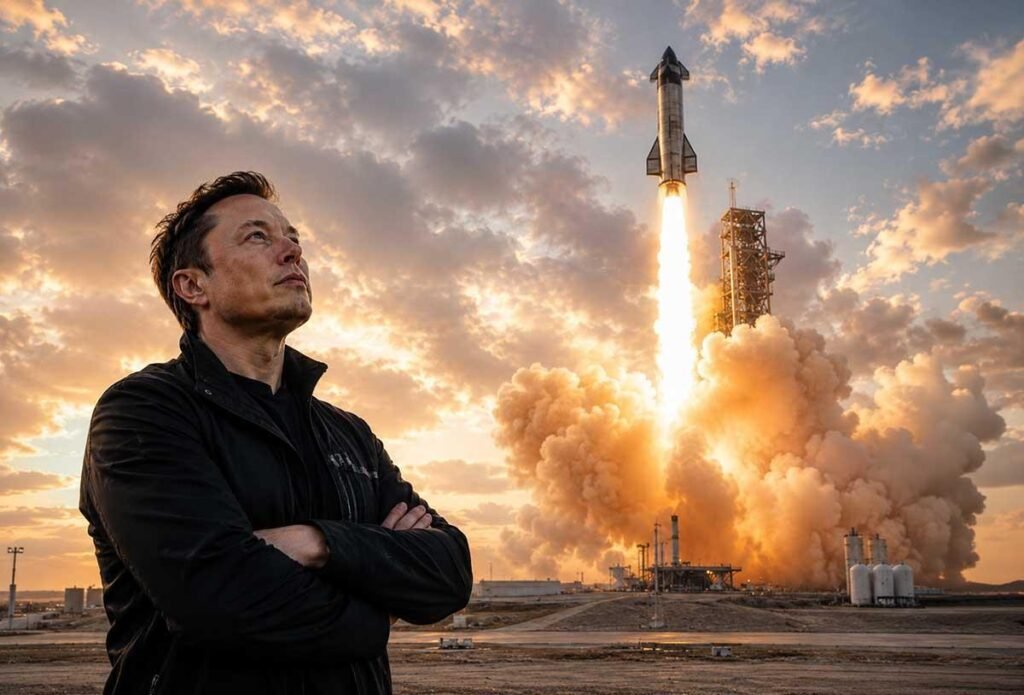
SpaceX Elon Musk Risk
The Biggest Strength Could Also Become the Biggest Weakness
SpaceX Elon Musk risk is becoming an increasingly important issue for investors as the rocket company enters the public markets with enormous expectations surrounding its founder and CEO.
- SpaceX Elon Musk Risk
- The Biggest Strength Could Also Become the Biggest Weakness
- Why Musk Matters So Much
- SpaceX Has Admitted There Is a Succession Problem
- Musk’s Control Adds Another Layer of Risk
- The Founder Advantage Is Real
- The Steve Jobs Comparison
- Musk Already Runs Multiple Companies
- What Investors Should Watch
- A Risk That Cannot Be Ignored
- Conclusion
SpaceX has been built around ambitious goals, including reusable rockets, Starlink satellite internet and eventually making life multiplanetary. Musk’s leadership has been central to that story. But that same dependence creates a difficult question for shareholders: What happens if Musk is suddenly unable to lead the company?
SpaceX itself acknowledged the concern in its IPO filing, describing Musk as a critical force behind its growth, innovation and operations. The company warned that his loss could significantly disrupt its management structure.
Why Musk Matters So Much
The SpaceX Elon Musk risk is different from the ordinary possibility that a CEO might leave a company.
Musk is not simply an executive overseeing SpaceX. His personality, engineering vision, public profile and ability to attract talent and capital have become closely connected to the company’s identity.
He founded SpaceX in 2002 and has remained deeply involved in its direction. The company has grown from an ambitious startup into a major force in commercial spaceflight and satellite communications.
That history makes investors wonder whether another executive could maintain the same combination of technical ambition, risk-taking and long-term vision.
SpaceX Has Admitted There Is a Succession Problem
One of the most significant warnings comes directly from SpaceX’s own regulatory disclosure.
The company says it is highly dependent on Musk’s continued service and performance. It also acknowledges that finding a successor with his combination of skills and experience could be difficult and uncertain. According to the company’s filing, there is no guarantee that an appropriate replacement could be found quickly—or at all.
That admission makes the SpaceX Elon Musk risk more than a theoretical concern.
For investors, succession planning is normally considered an important part of corporate governance. A company should ideally be able to continue operating effectively even when its top executive is no longer available.
Musk’s Control Adds Another Layer of Risk
The issue becomes even more complicated because of Musk’s extraordinary voting power.
Following SpaceX’s public offering, Musk retains control of more than 80% of the company’s voting power through its dual-class share structure, according to reporting on the IPO. That gives him enormous influence over the company’s strategic direction and board.
For supporters, this structure can be attractive because it allows Musk to pursue long-term projects without being pressured by short-term market demands.
For other investors, however, concentrated control can create concerns.
If shareholders disagree with an important decision, their ability to influence the company’s leadership may be limited.
The Founder Advantage Is Real
It would be unfair to discuss the SpaceX Elon Musk risk without recognizing the other side of the argument.
Musk’s leadership has helped SpaceX accomplish things that once seemed extremely difficult. The company has transformed the commercial launch industry and built Starlink into a major satellite communications business.
His willingness to pursue ambitious projects has also helped SpaceX attract engineers, investors and customers.
That founder-driven approach can be a powerful competitive advantage. Investors are not simply buying a collection of rockets and satellites; they are buying into a company whose strategy has been heavily shaped by Musk’s vision.
The problem is that the same advantage can become a vulnerability if too much of the company’s value depends on one individual.
The Steve Jobs Comparison
Corporate governance experts have compared Musk’s position to that of Apple’s Steve Jobs.
Jobs was deeply associated with Apple’s identity, and concerns about his health affected investor confidence. However, Apple eventually had a clear successor in Tim Cook, who was already a familiar figure to investors when Jobs stepped down.
That transition helped demonstrate that Apple’s operations and culture could survive beyond its famous founder.
The SpaceX Elon Musk risk raises a different question: Has SpaceX developed the same kind of leadership depth and succession structure?
Some experts argue that investors have not yet seen enough evidence to answer that confidently.
Musk Already Runs Multiple Companies
Another concern is the enormous number of responsibilities competing for Musk’s attention.
Beyond SpaceX, Musk has leadership roles and major interests connected to companies including Tesla, xAI, Neuralink and The Boring Company.
That means SpaceX must compete with several other businesses for the founder’s time.
The company has experienced executives capable of handling day-to-day operations, but the larger question is whether Musk’s unique strategic vision has been successfully transferred to those leaders.
That distinction could become extremely important over time.
What Investors Should Watch
Investors evaluating the SpaceX Elon Musk risk should look beyond rocket launches and financial growth.
They should also watch for signs that SpaceX is building a leadership structure capable of functioning without Musk.
Important questions include:
- Does SpaceX have a credible succession plan?
- Can senior executives make major decisions independently?
- Is the company’s culture institutionalized beyond Musk?
- How would markets react if Musk reduced his involvement?
- Can SpaceX maintain its technological momentum under different leadership?
The answers could influence how investors value the company over the long term.
A Risk That Cannot Be Ignored
SpaceX’s extraordinary success makes the founder-dependence issue particularly complicated.
Musk is arguably one of the company’s greatest assets. His ambition has helped create a culture that constantly pushes technological boundaries.
But investors generally want businesses to become stronger than any single individual.
A company capable of surviving leadership changes is usually more resilient than one whose future depends heavily on one person.
For SpaceX, proving that resilience could become one of its most important challenges as a public company.
Conclusion
The SpaceX Elon Musk risk does not mean the company is destined to struggle without its founder. SpaceX has talented engineers, experienced executives and powerful businesses such as Starlink. But Musk’s extraordinary influence creates a genuine succession challenge that investors should not overlook.
The strongest long-term outcome would be for SpaceX to preserve Musk’s entrepreneurial culture while building a leadership system that can operate successfully without him.
For shareholders, that may ultimately be the most important test of all: whether SpaceX can turn one man’s extraordinary vision into an institution capable of lasting for generations.
THANKS FOR READING
