
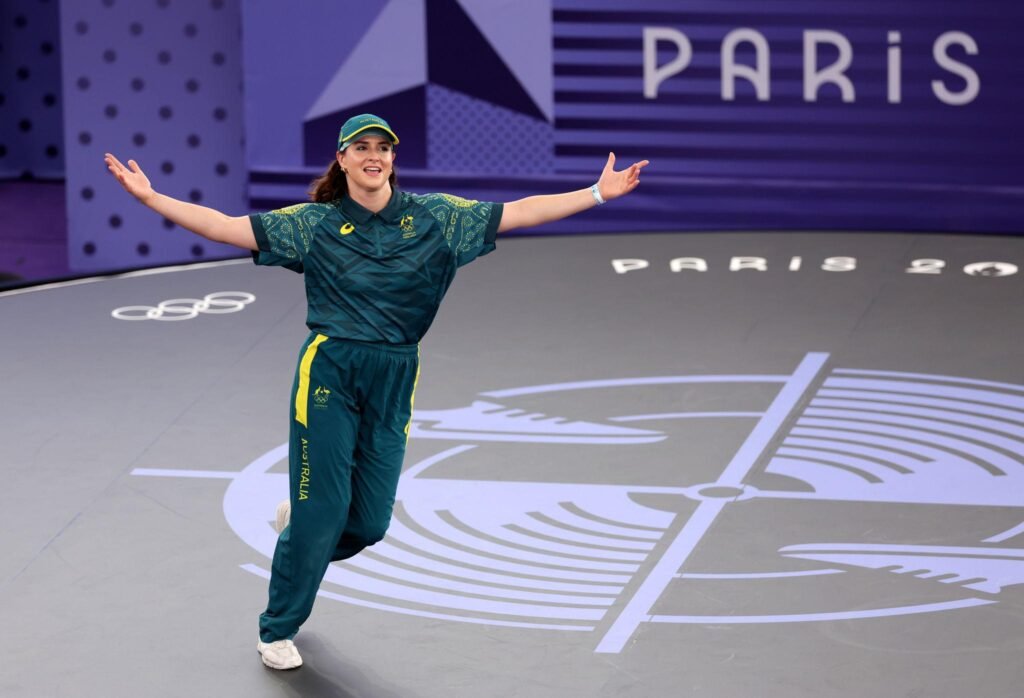
Raygun Olympic Journey
Raygun Olympic Journey has entered a new chapter as Australian breakdancer Rachael Gunn opens up about the extraordinary experience that transformed her from an Olympic competitor into one of the world’s most recognizable internet figures.
- Raygun Olympic Journey
- From Olympic Dream to Global Sensation
- A Performance That Became a Meme
- Therapy Became Part of the Recovery
- “Paris Is Now Just a Part of My Story”
- She Still Defends Her Creativity
- The Cost of Going Viral
- A Different Kind of Olympic Legacy
- The Documentary Gives Her More Control
- She Wants People to See the Person Behind the Meme
- A New Professional Chapter
- Why Gender Became Part of the Conversation
- The Internet Rarely Forgets
- From Embarrassment to Acceptance
- What Comes Next for Raygun?
- Why This Story Matters
- Summary
Two years after her controversial appearance at the 2024 Paris Olympics, Gunn says she has finally gained enough distance to talk openly about what happened. Therapy, time and a renewed focus on her mental health have helped her process the enormous attention that followed her performance.
Her story is now being explored in the Netflix documentary Untold Raygun: Breaking Badly, which premiered September 1. The film examines her journey into breaking, her road to the Olympics, the viral reaction to her performance and the personal consequences of becoming a worldwide meme.
From Olympic Dream to Global Sensation
Gunn entered the Paris Olympics with an unusual path behind her.
Unlike many elite competitors who begin training in their childhood, she came to breaking later in life. She developed an academic career and earned a Ph.D. while also becoming deeply involved in the Australian breaking community.
Her Olympic appearance was therefore the culmination of years of work.
But almost immediately after she competed, the conversation moved away from her athletic journey and toward the unusual movements she performed on the Olympic stage.
Her routine included movements that viewers compared to a kangaroo and a sprinkler. The performance quickly spread across social media, turning Gunn into a global viral sensation.
A Performance That Became a Meme
Breaking made its Olympic debut in Paris, creating enormous worldwide interest.
Gunn’s performance, however, generated a reaction that few athletes could have predicted.
She lost all three of her round-robin battles, and the performance became the subject of jokes, memes and commentary across the internet.
The attention continued long after the competition ended.
For Gunn, the problem was not simply losing.
It was suddenly seeing her identity reduced to a handful of viral clips.
In her recent interview, she described the experience as surreal and said she eventually had to learn to accept what had happened rather than constantly trying to control how other people viewed her.
Therapy Became Part of the Recovery
The emotional aftermath was difficult.
Gunn has spoken about the intense online scrutiny, unwanted attention and the psychological toll of becoming the target of worldwide ridicule.
Therapy became an important part of her recovery.
Rather than trying to erase the Olympic experience, she says she has worked toward accepting it as one part of a much larger life story.
That change in perspective appears to have been important.
Instead of asking how she could make everyone understand her performance, she began focusing on the things she could actually control: her own choices, reactions and future.
“Paris Is Now Just a Part of My Story”
One of the clearest signs of Gunn’s changed perspective is the way she now talks about the Olympics.
She has described Paris as simply one chapter of her life.
That does not mean she has forgotten what happened.
Instead, she appears to have reached a place where the experience no longer defines her entire identity.
Her message is particularly striking because the internet often preserves viral moments indefinitely.
A performance that lasts only a few minutes can be watched millions of times for years.
But Gunn is trying to move beyond that frozen version of herself.
She Still Defends Her Creativity
Despite the criticism, Gunn has not abandoned the artistic philosophy behind her performance.
Before and after the Olympics, she argued that creativity was central to her approach to breaking.
Her style was different from the power-focused routines many viewers expected to see.
That difference became part of the controversy.
But Gunn says she intentionally wanted to express herself rather than simply imitate other competitors.
In her latest reflections, she remains proud that she went onto the Olympic stage and performed in a way that felt authentic to her.
The Cost of Going Viral
Going viral can look glamorous from the outside.
For Gunn, it was anything but simple.
She suddenly became recognizable around the world, while journalists, television shows, comedians and social-media users discussed her performance.
Some attention was playful.
Other reactions were deeply hurtful.
The situation was made worse by false and unfounded claims surrounding her Olympic qualification and her relationship with her husband and coach, Samuel Free. Those claims added another layer to an already overwhelming experience.
The episode illustrates how quickly social media can turn a single moment into an international narrative that becomes difficult for the person involved to control.
A Different Kind of Olympic Legacy
Gunn did not win an Olympic medal.
Yet her Olympic appearance became one of the most discussed moments of the Paris Games.
That creates a complicated legacy.
Athletes generally hope to be remembered for victories, records and medals.
Gunn became famous for something entirely different.
Her story demonstrates that Olympic fame does not always follow the traditional path.
Sometimes, an athlete can become globally recognized because a performance connects with audiences in an unexpected way.
The Documentary Gives Her More Control
The Netflix documentary offers Gunn an opportunity to tell the story from her perspective.
Instead of being represented only through short social-media clips, audiences can see the years of preparation, the emotional pressure and the consequences that followed.
That broader context matters.
A viral video can show what happened in a few seconds.
A documentary can explore why it happened and what came afterward.
For Gunn, that distinction may be one of the most important parts of this new chapter.
She Wants People to See the Person Behind the Meme
At the center of Gunn’s story is a simple idea: she is more than an internet joke.
The documentary explores her life before Paris and what happened after she became famous.
She has described wanting to reclaim her narrative and move forward rather than remain permanently associated with one Olympic routine.
That is part of why the documentary arrives at an important moment.
Enough time has passed for Gunn to reflect, but the Paris Olympics remain recent enough for audiences to remember exactly how quickly her performance became a global phenomenon.
A New Professional Chapter
Gunn’s life has also changed professionally.
She has stepped away from competitive breaking and has moved toward public speaking, education and performance.
She also remains connected to the breaking community and has continued participating in dance-related activities.
Her experience gives her a perspective that extends beyond sport.
She can now speak about creativity, resilience, online criticism and the complicated relationship between public attention and personal identity.
Why Gender Became Part of the Conversation
Gunn has also discussed how gender influenced the reaction to her performance.
She believes female athletes can sometimes face a different kind of scrutiny, particularly when their appearance, personality or style does not fit conventional expectations.
That issue adds another dimension to the story.
The conversation is no longer simply about whether her Olympic routine was good or bad.
It raises broader questions about who gets to define athletic excellence and how quickly audiences judge people who do something unconventional.
The Internet Rarely Forgets
Perhaps the biggest lesson from the Raygun Olympic Journey is the permanence of online attention.
A person can experience an extraordinary moment, make one mistake or simply do something unusual, and suddenly millions of people may have an opinion.
The attention can disappear from the news cycle while remaining permanently searchable online.
Learning to live with that reality requires more than ignoring social media.
It can require time, professional support and a willingness to accept that some things cannot be controlled.
From Embarrassment to Acceptance
Gunn’s latest comments suggest that acceptance has become central to her recovery.
She does not appear to be trying to rewrite history.
Instead, she is acknowledging that the Paris experience happened, that it hurt, and that she can still move forward.
That may ultimately prove to be more powerful than trying to convince every critic that they were wrong.
What Comes Next for Raygun?
The future appears less focused on competitive medals and more focused on storytelling, creativity and community.
Her documentary gives audiences an opportunity to understand the person behind the viral clips.
She can also use the attention to discuss issues surrounding mental health, artistic freedom and the pressures of modern internet culture.
Whether audiences change their opinion of her performance is almost beside the point.
The bigger achievement may be that Gunn is finally able to discuss it on her own terms.
Why This Story Matters
The Raygun Olympic Journey is ultimately about much more than one controversial dance routine.
It is a story about what happens when an ordinary person suddenly becomes globally famous, how quickly online attention can become overwhelming, and how difficult it can be to reclaim a personal identity after becoming a meme.
Gunn’s willingness to talk after years of therapy also offers a different kind of Olympic story—one in which resilience is measured not by medals, but by the ability to move forward after an extraordinarily difficult experience.
Summary
The Raygun Olympic Journey has entered a new phase as Rachael Gunn opens up about the emotional aftermath of her viral 2024 Paris Olympics performance. After facing intense online criticism, memes and false claims, Gunn says therapy and time helped her gain perspective and accept Paris as one part of her story. Her experience is now explored in Netflix’s Untold Raygun: Breaking Badly, giving her an opportunity to provide context beyond the short clips that made her famous. Although she has stepped away from competitive breaking, Gunn continues to embrace creativity, public speaking and the wider breaking community. Her story has become a powerful reminder that behind every viral moment is a real person who must live with the consequences long after the internet moves on.
THANKS FOR READING
