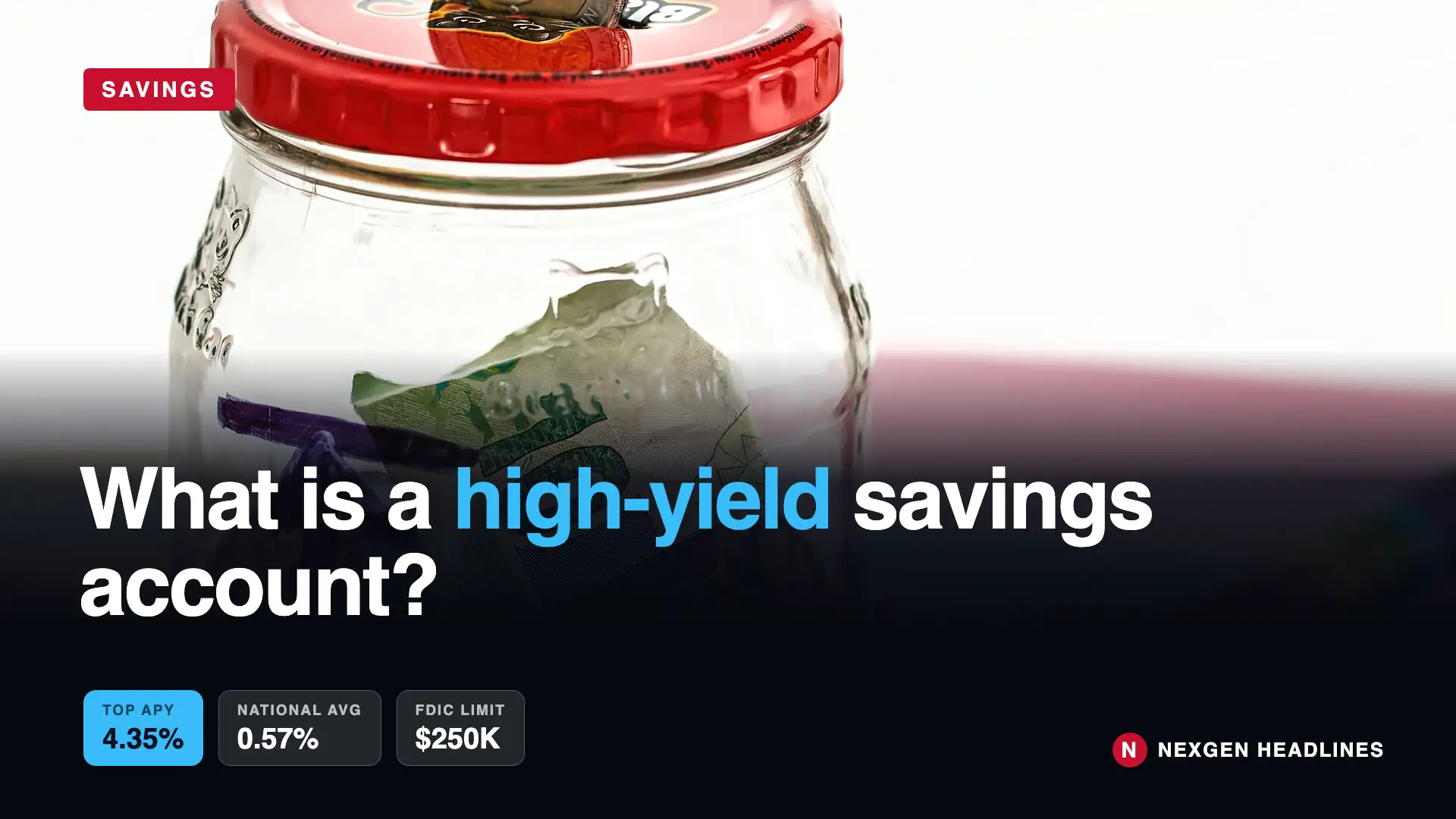

Quick answer: A high-yield savings account is a regular savings account that pays a much higher interest rate than a typical bank savings account. As of mid-November 2026, Bankrate listed top online savings rates around 4.35% APY, while its national average was about 0.57% APY. Your money stays safe up to $250,000 per depositor, per bank, per ownership category when the bank is FDIC-insured (or NCUA-insured at a credit union).
If your emergency fund sits in a big-bank savings account earning almost nothing, this is the easiest money fix you can make this year. Here’s how these accounts work, what to watch for, and how to open one in about 15 minutes.
High-yield savings account at a glance
| Question | Answer |
|---|---|
| What it is | A savings account that pays a higher APY than average |
| Top rates (Bankrate, Nov. 2026) | About 4.35% APY |
| National average (Bankrate, Nov. 2026) | About 0.57% APY |
| FDIC national savings rate (August 2026) | 0.38% |
| Is the rate fixed? | No. It’s variable and can change any time |
| Insurance | Up to $250,000 per depositor, per bank, per ownership category (FDIC or NCUA) |
| Where you find them | Mostly online banks, some credit unions and big-bank online brands |
| Best use | Emergency fund and short-term goals (1–3 years) |
How a high-yield savings account works
It works like any savings account. You deposit money, the bank pays you interest, and you can withdraw when you need to. The difference is the rate.
Online banks don’t pay for big branch networks. They pass part of those savings to customers as higher interest. That’s why most of the best rates come from online-only banks.
Interest is usually compounded daily and paid monthly. So each month you earn interest on your deposit plus the interest you already earned.
The rate is shown as APY (annual percentage yield). APY already includes compounding, so it’s the best number to compare between banks.
Why the rate moves
High-yield rates follow the Federal Reserve’s benchmark rate. When the Fed cuts rates, banks usually lower savings APYs within weeks. When the Fed raises rates, APYs tend to climb.
That means the rate you see today is not a promise. If you want a locked rate, look at a certificate of deposit (CD) instead.
How much more you could earn
The gap between an average account and a top account is big. Here’s a simple one-year comparison, assuming rates stay the same all year (they usually won’t, so treat these as estimates).
| Balance | At 0.57% APY | At 4.35% APY | Difference |
|---|---|---|---|
| $1,000 | $5.70 | $43.50 | $37.80 |
| $5,000 | $28.50 | $217.50 | $189.00 |
| $10,000 | $57.00 | $435.00 | $378.00 |
| $25,000 | $142.50 | $1,087.50 | $945.00 |
Many big banks pay even less than the average, sometimes 0.01%. On $10,000, that’s $1 a year.
Made-up examples (for illustration):
Maria, 34, keeps an $8,000 emergency fund at her big bank earning 0.01%. She moves it to an online bank paying 4.35% APY. If that rate held for a year, she’d earn about $348 instead of less than $1. She keeps her checking account where it is and links the two.
Derek, 51, chases a 5% “teaser” rate that only applies to the first $1,000 and drops after three months. He ends up earning less than he would have at a steady 4% account. Reading the fine print would have saved him the hassle.
How to open a high-yield savings account: step by step
- Compare current APYs. Check a rate table and the bank’s own website. Rates change often, so confirm the number on the day you apply.
- Check the insurance. Use the FDIC’s BankFind tool (or NCUA’s credit union locator) to confirm the bank is insured. If it’s a fintech app, find the partner bank’s name.
- Read the fee and minimum rules. Look for monthly fees, minimum balances to earn the top rate, and withdrawal limits.
- Gather your details. You’ll need your Social Security number, a government ID, your address and your current bank’s routing and account numbers.
- Apply online. Most applications take 10–15 minutes.
- Link your checking account. The bank may send two small test deposits to confirm it, which can take 1–3 business days.
- Move your money. Start a transfer, then set up an automatic monthly deposit so your savings grow without thinking about it.
Also read: How to build an emergency fund from scratch
What to look for (and what to avoid)
- No monthly fee. Most good high-yield accounts charge none. A $5 fee can wipe out the interest on a small balance.
- Low or no minimum. Some accounts pay the top rate only above a balance like $5,000. Others pay it on every dollar.
- A steady rate history. Some banks pay top rates for a while, then quietly fall behind. Check how the rate moved over the past year.
- Fast transfers. Moving money to checking usually takes 1–3 business days. That’s fine for most emergencies, but plan for it.
- Watch teaser rates. A promo rate may last only a few months or apply only to part of your balance.
- Watch “boosted” rates. Some accounts pay more only if you have direct deposit or another product with the bank.
High-yield savings vs. other places to park cash
| Option | Rate type | Access | Best for |
|---|---|---|---|
| High-yield savings | Variable | Anytime (transfers take 1–3 days) | Emergency fund |
| Regular bank savings | Variable, usually very low | Instant at the same bank | Small buffer next to checking |
| Money market account | Variable | Often has checks or a debit card | Savings you want to spend from easily |
| Certificate of deposit (CD) | Fixed for the term | Penalty if you withdraw early | Money you won’t touch for a set time |
| I bonds | Fixed rate plus inflation rate | Locked for 12 months; penalty before 5 years | Inflation protection |
| Money market fund (brokerage) | Variable | Sell any business day | Cash in an investment account (not FDIC-insured) |
Is your money safe?
Yes, if the bank is FDIC-insured or the credit union is NCUA-insured. Coverage is $250,000 per depositor, per insured bank, for each ownership category. A joint account has its own coverage for each owner.
Be careful with fintech apps. Some apps aren’t banks. They hold your money at a partner bank. Your money is protected only if the app properly records that it’s yours at the insured bank. Ask the app which bank holds your funds.
A money market fund at a brokerage is different. It’s an investment, not a deposit, and it isn’t FDIC-insured.
Taxes on high-yield savings interest
Interest is taxed as ordinary income on your federal return. Most states tax it too.
If you earn $10 or more in interest, the bank will usually send you a Form 1099-INT early in the year. You must report all interest, even under $10.
A higher rate still leaves you ahead after taxes. Just don’t spend the whole interest amount in your head before tax season.
Who should open one
- Anyone with an emergency fund sitting in a low-rate account.
- People saving for a near-term goal: a car, a wedding, a down payment, holiday spending.
- Retirees who keep a year or two of cash for living costs.
- Anyone who wants savings a little out of reach so they don’t spend it on impulse.
It’s not the best home for money you won’t need for 5+ years. Over long periods, investments like index funds have historically grown faster, with more risk.
Common mistakes
- Leaving savings at 0.01% out of habit. Moving it is free and takes minutes.
- Chasing every rate change. Switching banks for 0.1% isn’t worth the effort.
- Ignoring the partner bank behind a fintech app.
- Going over $250,000 in one ownership category at one bank.
- Forgetting the 1–3 day transfer time in a real emergency. Keep a small buffer in checking.
- Not reporting interest on your tax return.
Recommended products
Simple tools that help you stick to a savings plan.
Disclosure: As an Amazon Associate, Nexgen Headlines earns from qualifying purchases.
FAQ
Can you lose money in a high-yield savings account?
Not at an FDIC- or NCUA-insured institution, up to $250,000 per depositor, per bank, per ownership category. The rate can drop, but your deposit doesn’t shrink.
Is there a limit on withdrawals?
The Federal Reserve dropped the six-per-month rule in 2020, but many banks still set their own limits. Check your account terms.
How often do high-yield savings rates change?
Any time. They usually move after Federal Reserve rate decisions, but banks can change them whenever they want.
Should I keep my checking account at my old bank?
You can. Many people keep checking at a local bank and savings at an online bank, linked for transfers.
Is a high-yield savings account worth it for $500?
Yes, if there’s no fee or minimum. The dollars are small at first, but the habit and the rate help as your balance grows.
Bottom line
A high-yield savings account is a safe, insured savings account that simply pays more. With top rates near 4.35% APY and the average near 0.57% in November 2026, moving your emergency fund can earn hundreds of extra dollars a year. Pick an insured bank with no fees, link your checking, and automate your deposits.
Last reviewed: Nov. 23, 2026. Rates change often; confirm the current APY with the bank before you open an account.
Sources: FDIC: Deposit insurance, FDIC: National rates and rate caps, FRED: National rate, savings, Bankrate: Best high-yield savings accounts (Nov. 2026), CFPB, IRS: Form 1099-INT.
Featured image: Piggy bank. Photo: stevepb / Wikimedia Commons, CC0; edited by Nexgen Headlines.