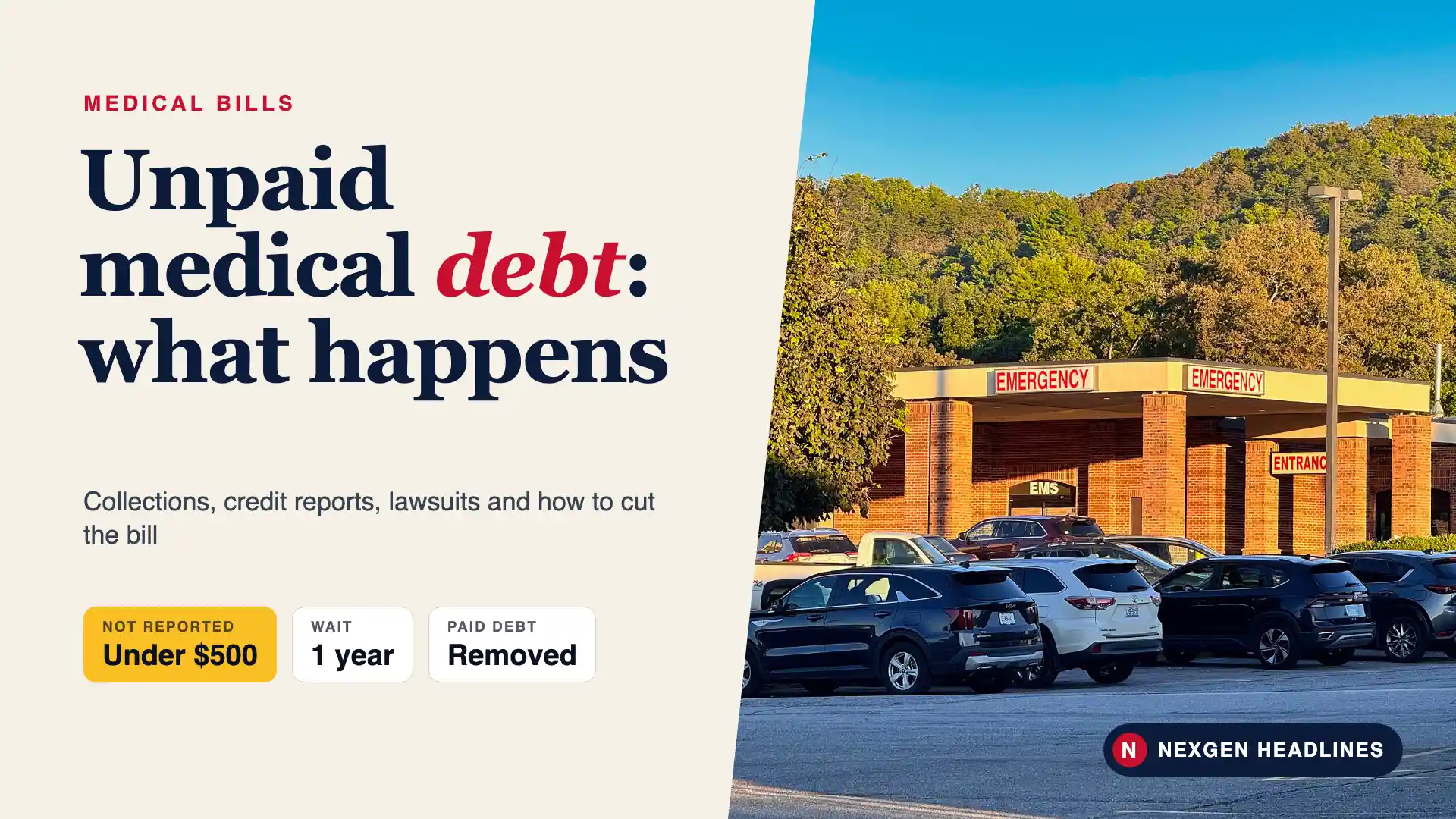

Quick answer: If you don’t pay a medical bill, it usually goes to collections after a few months. You may get calls and letters, and in some cases a lawsuit and wage garnishment. But the three credit bureaus don’t report medical collections under $500, wait one year before reporting larger ones, and remove paid medical debt. You have more options than most people think: ask for an itemized bill, apply for financial assistance, and negotiate.
KFF has estimated that about 1 in 12 U.S. adults owes more than $250 in medical debt, and the bills often come with no clear explanation. Ignoring them feels easier. It rarely is. Here’s exactly what happens, month by month, and how to stop it from hurting your credit or your paycheck.
What happens when you don’t pay a medical bill: timeline
| When | What usually happens |
|---|---|
| 0–30 days | You get a bill from the hospital, doctor, lab or ambulance company. |
| 30–120 days | Reminder statements and calls. Nonprofit hospitals must send notices and screen you for financial aid. |
| About 120–180 days | Many providers send or sell the account to a collection agency. |
| 1 year after the debt goes to collections | The earliest a medical collection over $500 shows up on Equifax, Experian or TransUnion reports. |
| Months to years later | Some collectors or providers sue. If they win, they may get a court order to garnish wages or freeze a bank account. |
| Up to 7 years | An unpaid collection can stay on your credit report this long from the first delinquency. |
Timelines vary by provider and state. The $500 and one-year rules are voluntary credit bureau policies, not federal law.
The credit report rules for medical debt in 2026
In 2022 and 2023, Equifax, Experian and TransUnion changed how they treat medical debt. These policies still apply today:
- Medical collections under $500 are not reported at all.
- Larger medical collections are not reported until they’ve been in collections for one year.
- Paid medical collections are removed from your report.
The Consumer Financial Protection Bureau (CFPB) went further in January 2025 with a rule that would have banned medical debt from most credit reports. A federal judge in Texas later vacated that rule, so it never took effect. The bureaus’ voluntary limits stay in place, but because they are voluntary, they could change.
Some states have their own laws. California, Colorado, New York and about a dozen other states ban or limit medical debt reporting. Whether the court ruling affects those state laws is still being argued, so check your state attorney general’s website.
Can you be sued for medical debt?
Yes. A provider or a debt buyer can sue you for unpaid medical bills, as long as the debt is within your state’s statute of limitations. In most states that’s between 3 and 6 years, but some are longer.
If you’re sued, do not ignore the court papers. If you don’t respond, the court can enter a default judgment against you. That can lead to:
- Wage garnishment. Federal law caps it at 25% of disposable pay, or the amount above 30 times the federal minimum wage, whichever is less. Some states protect more.
- Bank account levies, where money is taken directly from your account.
- A lien on property in some states.
Social Security and VA benefits get special protection from most private creditors. Your bank must protect two months of directly deposited federal benefits.
Also read: How to stop wage garnishment
What to do first: 7 steps that can shrink the bill
- Don’t pay right away, and don’t ignore it. Mistakes are common. Take a week to check the bill.
- Ask for an itemized bill. Look for duplicate charges, services you didn’t get, and wrong insurance info.
- Check your insurance’s Explanation of Benefits (EOB). Make sure the provider billed your insurer and that the “patient responsibility” matches.
- Check the No Surprises Act. For emergency care and some out-of-network care at in-network hospitals, you usually can’t be billed more than in-network cost-sharing.
- Apply for financial assistance (charity care). Every nonprofit hospital must have a written financial assistance policy. Many cover families earning up to 200%–400% of the federal poverty level.
- Negotiate. Ask for the cash or self-pay price, a prompt-pay discount, or a lower lump sum.
- Set up an interest-free payment plan directly with the provider before the bill goes to collections.
Your rights if the bill goes to collections
The federal Fair Debt Collection Practices Act (FDCPA) covers third-party debt collectors. Here’s what it gives you:
- A validation notice. The collector must tell you the amount, the creditor and your rights.
- 30 days to dispute. If you dispute in writing within 30 days, the collector must pause and verify the debt.
- Limits on calls. Collectors can’t call before 8 a.m. or after 9 p.m., and the CFPB presumes more than 7 calls in 7 days is harassment.
- No threats or lies. They can’t threaten arrest or claim you owe more than you do.
- The right to stop contact by asking in writing. The debt doesn’t go away, but the calls stop.
Send a debt validation letter by certified mail. Keep copies of everything.
Made-up examples (for illustration):
Maria gets a $2,400 ER bill. Her itemized bill shows a $600 duplicate CT scan charge. After the fix, she applies for the hospital’s financial aid. Her household earns 250% of the poverty level, and the policy cuts her bill by 60%. She ends up owing about $720 and sets up a $60-a-month plan with no interest.
James ignores a $380 lab bill. It goes to collections, but because it’s under $500, it never appears on his credit report. He still gets calls. He settles it for $250 and gets the agreement in writing first.
Should you pay a medical bill with a credit card?
Usually no. Once medical debt is on a credit card, it’s just credit card debt. It loses the special credit report protections, it can carry 20%+ interest, and you can’t get hospital financial aid on it later. A provider payment plan at 0% is almost always better.
Be careful with medical credit cards sold at the doctor’s office. Many use deferred interest: if you don’t pay the full balance by the end of the promo period, you owe all the interest back to day one.
How to negotiate medical debt
- With the provider: Ask, “What’s the lowest amount you’d accept if I pay today?” Discounts of 20% to 40% for a lump sum are common, but not guaranteed.
- With a collector: Debt buyers often paid pennies on the dollar. Start low, around 30% of the balance, and go up slowly.
- Get it in writing before you pay. The letter should say the amount settles the debt in full.
- Never give a collector access to your bank account. Pay with a money order or a one-time payment.
- Watch the statute of limitations. In some states, a small payment on an old debt can restart the clock.
Common mistakes to avoid
- Ignoring a lawsuit. This is the costliest mistake. Answer by the deadline, even if you owe the money.
- Taking out a personal loan or home equity loan to pay a medical bill you could have reduced.
- Paying a collector without validation. Some medical debts are sold with errors or have already been paid.
- Not applying for charity care because you think you earn too much. Many hospitals help middle-income families.
- Forgetting old bills. Pull your free credit reports at AnnualCreditReport.com to see what’s there.
What if you can’t pay anything?
If you truly can’t pay, you still have choices. Tell the provider in writing about your hardship. Ask them to hold the account while your financial aid application is reviewed. Nonprofit hospitals generally can’t take “extraordinary collection actions,” like lawsuits or credit reporting, until at least 120 days after the first bill, and must accept aid applications for 240 days.
If you’re judgment-proof (your only income is Social Security, SSI or VA benefits, and you have few assets), a collector may have little it can take. A free legal aid office or a nonprofit credit counselor (look for NFCC members) can help you decide. Bankruptcy is a last resort, but medical debt is dischargeable.
Recommended products
Simple tools to keep bills and paperwork organized.
Disclosure: As an Amazon Associate, Nexgen Headlines earns from qualifying purchases.
FAQ
Does medical debt go away after 7 years?
It drops off your credit report after 7 years from the first delinquency. But you may still legally owe it, and you can be sued if your state’s statute of limitations hasn’t run out.
Will a $300 medical bill hurt my credit?
Not under current credit bureau policy. Medical collections under $500 aren’t reported to Equifax, Experian or TransUnion.
Can a hospital refuse to treat me for unpaid bills?
For emergencies, no. Under the federal EMTALA law, hospitals with emergency rooms must screen and stabilize you regardless of ability to pay. For non-emergency care, a provider may ask you to pay old bills first.
Can medical debt be forgiven?
Yes, in several ways: hospital charity care, settlements, and charities like Undue Medical Debt that buy and cancel debt. Some states and cities have run debt relief programs too.
Can I go to jail for not paying medical bills?
No. You can’t be jailed for owing a debt. But you must respond to a lawsuit and obey court orders.
Bottom line
Unpaid medical bills can lead to collections and lawsuits, but they’re also the most negotiable debt you’ll ever have. Check the itemized bill, apply for financial assistance, ask for a 0% payment plan, and answer any lawsuit. Medical collections under $500 stay off your credit report, and paid ones are removed.
Last reviewed: Nov. 13, 2026. This is general information, not legal advice. State laws vary.
Sources: CFPB: Debt collection, CFPB: Medical debt rule (January 2025), Brownstein: Court vacates medical debt rule, IRS: Nonprofit hospital billing and collections (501(r)), CMS: No Surprises Act, U.S. Department of Labor: Wage garnishment.
Featured image: Hospital emergency department entrance. Photo: Harrison Keely / Wikimedia Commons, CC BY 4.0; edited by Nexgen Headlines.