Kalshi Tribal Prediction Markets
Kalshi Tribal Prediction Markets Create a New Divide
Kalshi Tribal Prediction Markets are creating a new debate across Indian Country as several Native American tribes move into the rapidly expanding prediction-market business while many other tribal gaming leaders warn that the industry could threaten casino revenues.
Four tribes in California and Oklahoma launched Kalshi-backed prediction apps on October 7, adding to a small but growing group of tribal nations exploring prediction markets as a source of economic development.
The split reflects two very different economic perspectives.
Some tribes see prediction markets as a chance to diversify their businesses and exercise greater economic self-determination.
Other tribal leaders see the growing market as a potential threat to an industry that has become essential for funding tribal governments, infrastructure and community programs.
At the center of the disagreement is a basic question: Can prediction markets create new economic opportunities for tribes without taking money away from tribal casinos?
There is no consensus yet.
Why Some Tribes Are Partnering With Kalshi
For smaller tribes that have not benefited significantly from the casino industry, a digital financial business can look very different from traditional gaming.
Eric Wright, administrator for the Kletsel Dehe Wintun Nation in Northern California, told CNN that his tribe hopes revenue from its new Kalshi-backed prediction app can help pay for basic infrastructure projects, including water improvements.
The tribe is located in an isolated area where residents lack potable drinking water.
Wright said the decision is about tribal sovereignty and the ability of individual nations to make their own economic decisions.
That argument is important because Native American tribes are sovereign governments with different economic circumstances.
A strategy that makes sense for a small tribe without a major casino operation may not make sense for a tribe whose government depends heavily on gaming revenue.
The new prediction-market partnerships therefore reflect differences within Indian Country rather than a single tribal position.
Tunica-Biloxi Started the New Model
The first tribal nation to formally enter the prediction-market industry was the Tunica-Biloxi Tribe of Louisiana.
In September, the tribe launched SaltTrade Derivatives, a tribal-owned enterprise using Kalshi’s infrastructure.
The venture allows customers to trade event contracts tied to future events through a structured marketplace. Kalshi provides the underlying exchange infrastructure, while the tribal enterprise operates its own brand and customer-facing business.
Tunica-Biloxi Chairman Marshall Pierite described the partnership as a way to diversify the tribe’s economy and develop new sources of revenue.
The company says the project represents an effort to give tribal nations more opportunities to participate as owners and innovators in emerging industries.
The partnership also reflects a broader argument from Kalshi: prediction markets and tribal casinos can exist alongside one another rather than necessarily competing for exactly the same customers.
But opponents remain unconvinced.
Why Other Tribes Are Worried
Many tribal leaders view prediction markets through the lens of their existing gaming businesses.
Tribal casinos are not simply entertainment venues.
For many tribes, gaming revenue supports government operations and services that might otherwise be difficult to finance.
The National Indian Gaming Commission reported that tribal gaming generated $46.2 billion in gross gaming revenue during fiscal year 2025, a record outside the post-pandemic recovery period.
That makes the expansion of online prediction markets particularly significant.
More than 80% of prediction-market trading volume currently comes from sports-related contracts, according to CNN’s reporting.
Sports betting is also an important part of the modern gaming economy.
Tribal leaders therefore worry that customers who previously used tribal sportsbooks or casinos could move some of their activity to prediction-market platforms.
However, there is an important limitation to that argument.
Tribal leaders interviewed by CNN did not provide data showing that their casino revenues had already fallen because of prediction markets this year. The concern is largely about the potential future impact as the new industry expands.
The Legal Fight Is Just as Important
The economic debate is happening alongside a major legal fight.
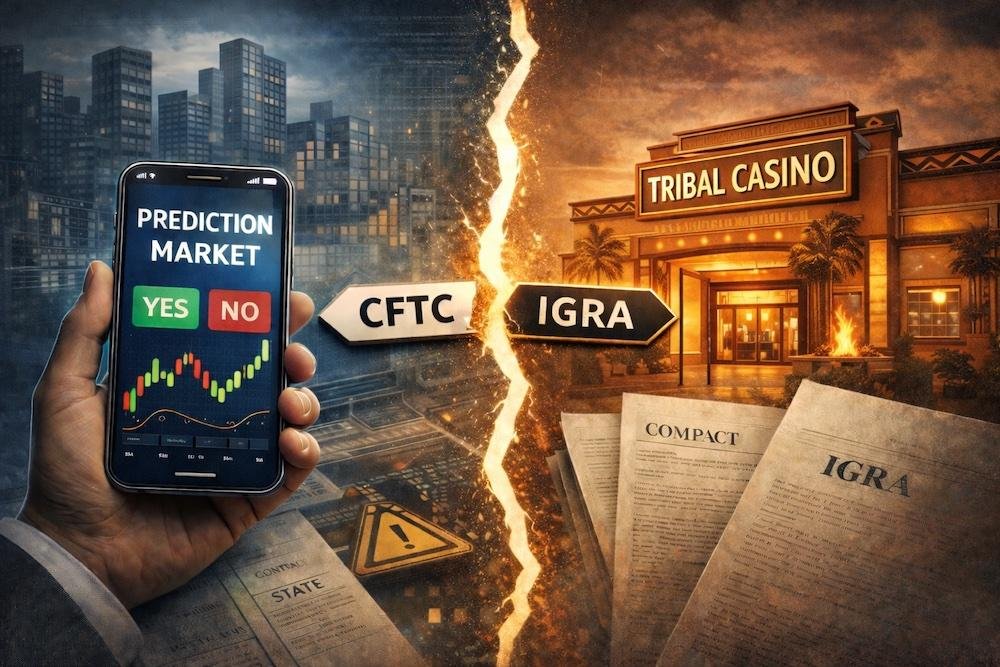
Kalshi operates as a federally regulated derivatives exchange under the Commodity Futures Trading Commission.
The company argues that its event contracts are financial products rather than traditional sports bets.
Many tribes and states disagree.
They argue that sports event contracts function like wagers and therefore should be subject to state and tribal gaming rules.
The dispute has reached federal courts.
On September 16, the Ninth U.S. Circuit Court of Appeals blocked Kalshi from offering sports event contracts on lands belonging to two California tribes, Blue Lake Rancheria and Chicken Ranch Rancheria of Me-Wuk Indians.
The court granted a preliminary injunction after concluding that the tribes were likely to succeed in arguments involving the Indian Gaming Regulatory Act and tribal gaming rules.
The decision does not resolve every legal question surrounding prediction markets nationwide.
Other courts have reached different conclusions.
That means the broader dispute remains unsettled.
One Court Reached a Different Conclusion
The legal landscape is complicated by conflicting rulings.
In Wisconsin, a federal judge ruled in May that the Ho-Chunk Nation had provided little evidence that its casinos were losing customers to Kalshi.
The judge declined to block Kalshi’s operations within the tribe’s borders.
The conflicting decisions highlight why the issue could eventually reach the U.S. Supreme Court.
At stake is more than one company’s business model.
The courts are being asked to consider how federal derivatives law interacts with state gambling laws and the federal legal framework governing tribal gaming.
What Is the Indian Gaming Regulatory Act?
The Indian Gaming Regulatory Act, commonly known as IGRA, was enacted by Congress in 1988.
It created a federal framework for tribal gaming while recognizing tribal interests in conducting gaming activities on Indian lands.
Tribal gaming subsequently became a major source of economic activity for many Native American communities.
The current prediction-market dispute raises questions about whether federally regulated event contracts can operate on tribal lands without being treated as tribal gaming.
That question has become central to the legal cases involving Kalshi.
For tribes that oppose prediction markets, the issue is closely connected to their existing gaming rights.
For tribes partnering with Kalshi, the issue is framed differently: They see the new technology as another tool that sovereign nations can choose to use for economic development.
Kalshi Says Prediction Markets Are Different
Kalshi maintains that its business model is fundamentally different from a traditional sportsbook.
The company describes its platform as an exchange where buyers and sellers trade contracts based on future events.
Kalshi says it earns transaction fees rather than simply taking the opposite side of customers’ trades.
The company also argues that prediction markets serve audiences that are not necessarily the same people who visit sportsbooks.
Kalshi says some users come to the platform specifically because they want to trade information about economic, political, entertainment or other events.
That distinction is central to its legal and economic argument.
Opponents, however, say the structure of sports contracts matters more than the terminology used to describe them.
Tribal Leaders Are Not Speaking With One Voice
Perhaps the most important part of the debate is that there is no single tribal position.
Some tribal organizations and casino leaders are working to restrict prediction markets.
Others are exploring partnerships.
Michael Stopp, a Cherokee businessman involved with the prediction app launched by the Alabama-Quassarte Tribal Town in Oklahoma, told CNN that digital prediction platforms do not necessarily replace the experience of visiting a casino.
He argued that tribes should have the opportunity to evaluate the industry themselves.
That position reflects a broader principle: tribal sovereignty allows different nations to pursue different economic strategies.
A tribal government with major casino operations may prioritize protecting existing revenue.
A smaller tribe may place greater value on finding entirely new sources of income.
The CFTC Is Also Under Pressure
The Commodity Futures Trading Commission has become another major player in the dispute.
CFTC Chairman Mike Selig met with tribal leaders in Washington last month to discuss prediction markets.
According to CNN, the meeting was described differently by the participants.
Some tribal representatives said they felt their concerns had not been adequately addressed.
A senior CFTC official characterized the meeting as productive and said the agency had assigned a staff member to add tribal engagement to its responsibilities.
The disagreement demonstrates how difficult it is to create a regulatory framework that satisfies both the financial markets industry and tribal gaming interests.
What Happens Next?
The future of Kalshi Tribal Prediction Markets will likely depend on both business results and court decisions.
If tribal partnerships generate meaningful revenue without reducing casino activity, more tribes could become interested.
If casino operators begin documenting significant revenue losses, opposition could become stronger.
Meanwhile, the legal cases could determine whether sports prediction contracts can operate on tribal lands and how federal derivatives law interacts with tribal gaming protections.
The Supreme Court could ultimately be asked to resolve the broader conflict, although the timing and exact legal questions remain uncertain.
A New Economic Opportunity or a Threat?
The debate cannot easily be reduced to one side being for tribes and the other being against them.
Both sides are arguing from concerns about tribal economic independence.
The tribes partnering with Kalshi say they want more choices.
The tribes opposing prediction markets say they want to protect economic systems that already support their communities.
Those positions can exist simultaneously because tribal nations have different needs and economic structures.
The next stage of the debate will be shaped by evidence: revenue data, consumer behavior, court rulings and the experience of tribes already operating prediction apps.
Important News Takeaway
Kalshi Tribal Prediction Markets are opening a new chapter in Native American economic development while creating a significant debate over the future of tribal gaming.
Four tribes in California and Oklahoma launched Kalshi-backed prediction apps on October 7, while the Tunica-Biloxi Tribe had already become the first tribal nation to enter the prediction-market industry through its SaltTrade Derivatives venture.
Supporters describe the partnerships as an opportunity for economic diversification and tribal self-determination. Opponents worry that rapidly expanding sports prediction markets could compete with casino revenue that supports tribal governments and community services.
At the same time, federal courts are still wrestling with whether sports prediction contracts should be treated as financial derivatives or as a form of gaming subject to tribal and state rules.
For Indian Country, the debate is ultimately about who gets to decide what the next generation of tribal economic development looks like.
THANKS FOR READING