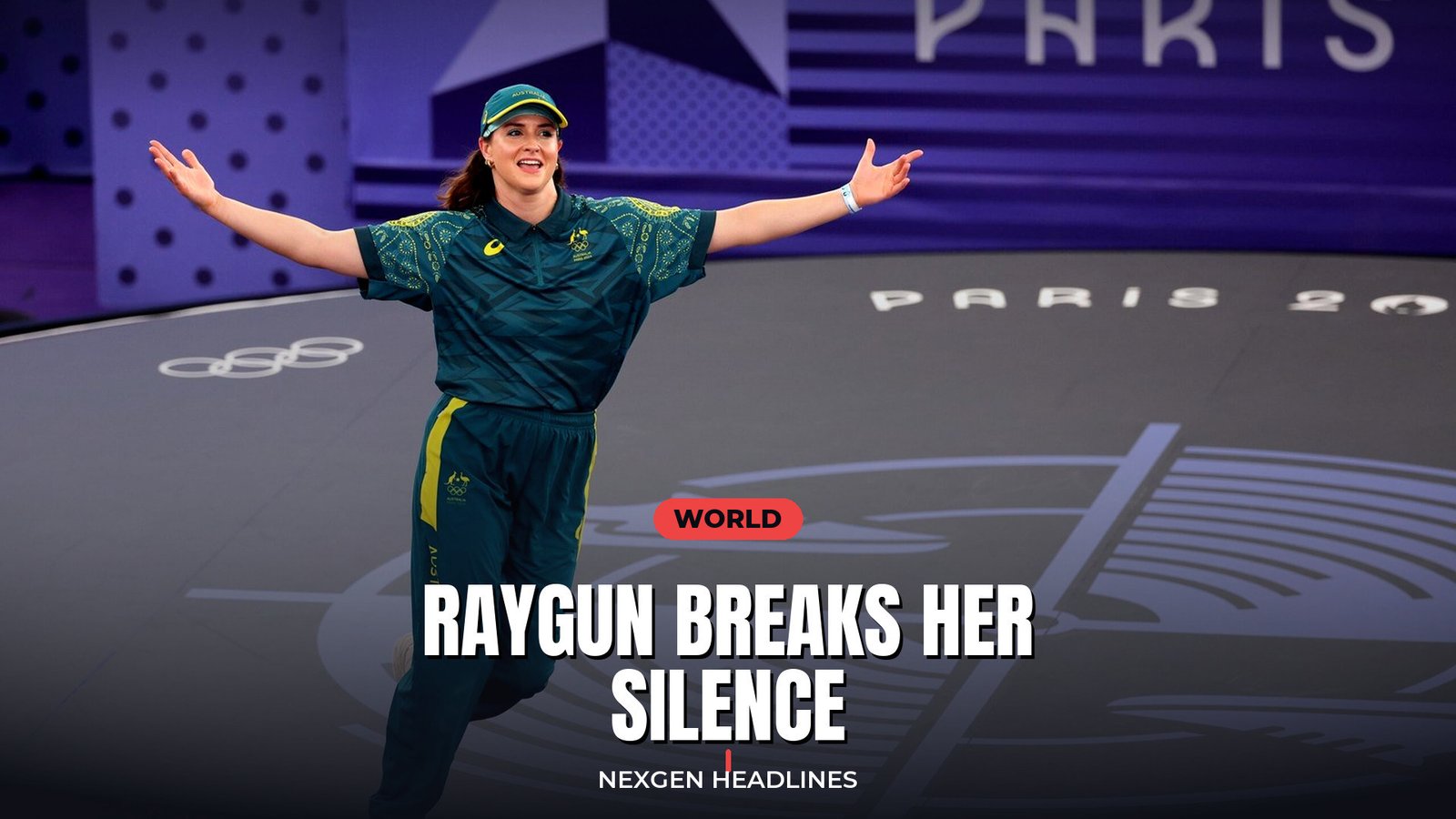

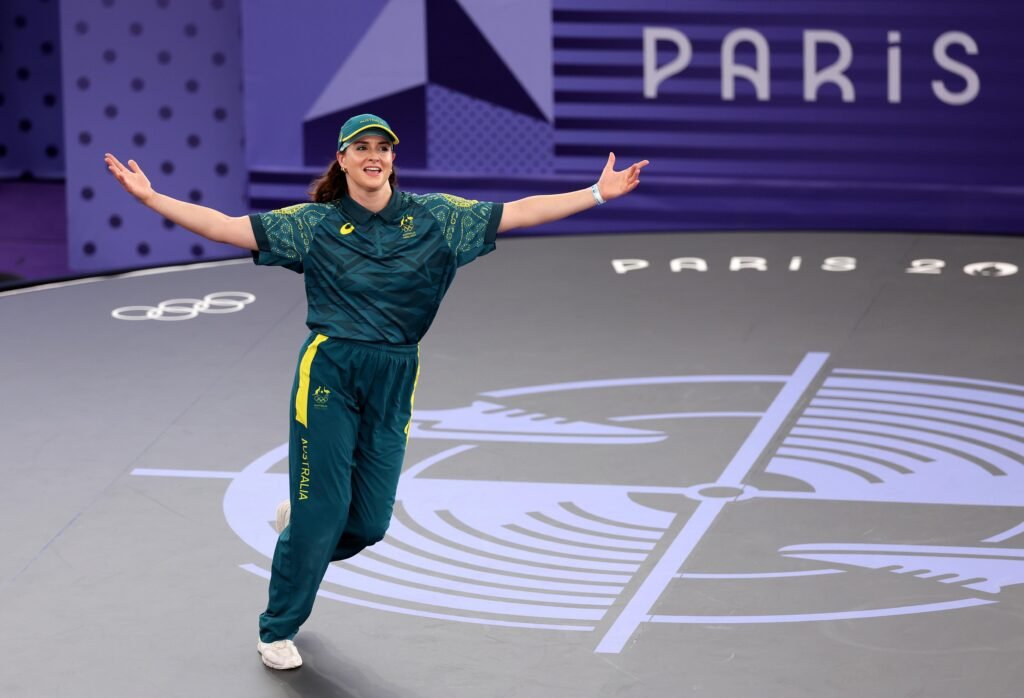
Raygun Olympic Journey Takes a New Turn
Raygun Olympic Journey has entered a very different chapter.
Two years after her unforgettable appearance at the 2024 Paris Olympics, Australian breaker Rachael Gunn is ready to talk more openly about what happened when her performance suddenly became one of the internet’s biggest stories.
Gunn, who competes under the name Raygun, became globally famous after breaking made its Olympic debut in Paris. Her unconventional routine, which included movements resembling a kangaroo hop and the sprinkler, quickly spread across social media.
The attention was enormous — but so was the criticism.
Now, after spending years processing the experience and working through the aftermath, Gunn says she has reached a place where she can look back at Paris with greater distance. In a recent interview, she described the Olympics as one part of her larger story rather than something that defines her entire life.
From Olympic Dream to Worldwide Meme
Before Paris, Gunn was an Australian breaker, academic and cultural studies researcher who had developed a distinctive approach to breaking.
Her Olympic qualification was a major achievement. She had earned her place through the Oceania qualifying process and arrived in Paris as Australia’s representative in the women’s breaking competition.
But her Olympic performance unfolded very differently from the way she had imagined.
Gunn lost all three of her round-robin battles and received no votes from the judges. Instead of simply becoming another athlete eliminated early in an Olympic competition, she became an international internet sensation.
Her unusual movements were clipped, reposted, parodied and turned into memes.
The reaction spread far beyond the breaking community.
What may have been a disappointing sporting result for another athlete became a global pop-culture moment for Gunn.
And unlike a normal competition result, the internet did not move on quickly.
The Attention Became Extremely Difficult to Handle
The biggest challenge came after the performance.
Gunn has explained that she expected some criticism. She knew her style was different from that of many other competitors, and she understood that viewers unfamiliar with breaking might not immediately understand her approach.
But the scale of the response was something she could not have predicted.
Memes and jokes circulated internationally. She also faced false claims and conspiracy theories about how she had qualified for the Olympics.
Those allegations were not supported by evidence, and the controversy added another layer to an already overwhelming experience. The breaking community and Australian sporting officials pushed back against some of the misinformation surrounding her selection.
Gunn has since spoken about how difficult it was to see herself reduced to a joke online.
For a person who had spent years developing her skills and studying breaking, suddenly being known almost entirely for a few viral clips was deeply frustrating.
Therapy Helped Her Rebuild Her Perspective
One of the most important parts of Gunn’s story is what happened after the cameras stopped.
Rather than simply ignoring the experience, she spent considerable time working through it.
In interviews connected with the new documentary, Gunn has discussed therapy and the process of learning what she could and could not control.
She eventually came to a powerful realization: she could not control what strangers posted online, what jokes people made, or how every viewer interpreted her performance.
But she could control her own response.
That change in perspective did not happen overnight.
Gunn has described the process as slow and difficult. She also found that returning to dance itself took time because of the association between breaking and the overwhelming attention that followed Paris.
Today, however, she says the work was worth it.
“Paris Is Now Just a Part of My Story”
Perhaps the clearest sign of Gunn’s recovery is the way she now describes the Olympics.
Instead of allowing Paris to become the final chapter of her story, she has chosen to see it as one chapter among many.
She has talked about accepting what happened and moving forward one step at a time.
That does not mean she believes everything about the experience was positive.
It means she no longer wants the worst parts of it to control her future.
That distinction is important.
The Raygun Olympic Journey was not simply about a dancer becoming famous. It was about what happens when a private person suddenly becomes the subject of worldwide attention.
Millions of people watched a few minutes of her performance.
Very few knew the person behind it.
The New Netflix Documentary Tells Her Side
Gunn’s decision to speak now is closely connected to Netflix’s documentary Untold Raygun: Breaking Badly.
The documentary premiered September 1, 2026, and looks at Gunn’s path into breaking, her preparation for the Paris Olympics and the extraordinary aftermath of her viral performance. Netflix describes the film as the story of an Australian academic who became a global meme and the infamy that followed.
The film gives viewers a much more personal look at Gunn’s experience.
It also shows that the Olympic moment did not begin when she walked onto the competition floor.
Her journey into breaking started much earlier, and she spent years developing her own identity within the culture.
That background is important because the viral clips often removed the performance from its wider context.
She Knew People Might Laugh — But Not Like This
One of the most striking revelations from the documentary is that Gunn had actually considered the possibility that people might laugh at her.
Before the Games, she discussed her fears with a therapist.
She understood that her unusual style could attract attention, particularly because she was competing on the world’s biggest sporting stage.
But imagining that possibility and actually experiencing it were two completely different things.
The documentary shows how quickly the situation spiraled after Paris.
Gunn went from being an athlete who had achieved an Olympic dream to someone whose face and dance moves were recognizable around the world.
That transformation happened almost overnight.
Why Her Story Is Bigger Than One Olympic Performance
The debate surrounding Raygun is complicated.
Some criticism focused on the quality and style of her Olympic performance. Others questioned representation, authenticity and the broader culture of breaking, a dance form with deep roots in Black and Latino communities in the Bronx. Critics have argued that those cultural questions deserve more attention than the viral jokes alone.
At the same time, Gunn’s supporters have argued that the intensity of the online ridicule went far beyond reasonable sports criticism.
Both conversations can exist at once.
An athlete’s performance can be criticized while the person behind it is still treated with dignity.
That distinction became increasingly important as Gunn’s story unfolded.
Raygun Is Building a Different Future
Gunn eventually stepped away from competitive breaking.
She has also moved away from her previous academic career and is now focusing more on speaking, education and creative work. She remains connected to the breaking community and has continued to support younger dancers and local events.
That represents a significant change from the person viewers saw in Paris.
Instead of trying to recreate her Olympic career, Gunn appears focused on using the experience to shape what comes next.
Her story has also given her a larger platform to discuss creativity, individuality and the pressure created by social media.
A Comeback Without Needing Another Competition
The most interesting thing about the next stage of the Raygun Olympic Journey is that Gunn does not need another Olympic appearance to prove anything.
Her comeback is personal rather than competitive.
She is reclaiming the ability to tell her own story.
The internet once defined Raygun through a handful of short videos.
Now, Gunn is giving people the opportunity to see the much longer story behind those clips.
That includes the years of work, the Olympic dream, the unexpected fame, the criticism, the recovery and the decision to keep moving forward.
A Powerful Lesson About Being Yourself
Gunn’s experience offers a lesson that reaches far beyond breaking.
The internet can turn an ordinary moment into a global event in seconds.
It can also reduce complicated people to simple labels.
But people are almost never as simple as a viral clip makes them appear.
Gunn has said that one of the most important things she learned was that she could not control other people’s reactions. What she could control was how she responded.
That idea now sits at the heart of her story.
The woman who once became famous because millions of strangers were laughing at her is now choosing to speak in her own voice.
And perhaps that is the most important part of the Raygun Olympic Journey.
Paris did not go the way she wanted.
The internet did not respond the way she expected.
But the story did not end there.
After years of reflection, therapy and distance, Raygun is ready to talk — and, more importantly, ready to move forward.
Why Gender Became Part of the Conversation
Gunn has also discussed how gender influenced the reaction to her performance. She believes female athletes can face a different kind of scrutiny, particularly when their appearance, personality or style does not fit conventional expectations.
That raises broader questions about who gets to define athletic excellence and how quickly audiences judge people who do something unconventional.
The Internet Rarely Forgets
Perhaps the biggest lesson from Gunn’s story is the permanence of online attention. A moment can disappear from the news cycle while remaining searchable forever. Learning to live with that can require time, professional support and a willingness to accept that some things cannot be controlled.
Summary
Rachael Gunn is opening up about the aftermath of her viral 2024 Paris Olympics performance. After intense online criticism, memes and false claims about her qualification, she says therapy and time helped her accept Paris as one part of her story. Netflix’s Untold Raygun: Breaking Badly, which premiered September 1, 2026, tells her side. She has stepped away from competitive breaking to focus on speaking, education and creative work, while staying connected to the breaking community.
THANKS FOR READING